
#16 Compound vs Catalyst Moves: The Two Forces That Drive Strategic Architecture

Welcome to the Strategic Architecture Universe: where compounding builds inevitability, catalysts create inflection points, and execution writes the strategy.
Edward Azorbo
The Two Types of Strategic Progress
Not all progress is created equal.
Most businesses improve incrementally, optimizing what already exists. But occasionally, a move doesn’t just improve the system, it transforms the entire architecture of what’s possible.
I discovered this distinction through two radically different training experiences in Brazilian Jiu-Jitsu. One pushed me through thousands of repetitions. The other shattered my entire understanding in a single week.
Understanding this pattern has changed how I approach strategy entirely.
The Compound Pattern: Death by a Thousand Rolls
I had a 3-month period when I was training BJJ hard. My coach Rogent would have me roll 4 times in a row, then rest, while my other 2 training partners would rest after each roll.
I was practically destroyed after each 1-hour session.
But something profound happened in those 3 months. I mechanized many moves, improved my overall system, and made rapid gains in my game.
The power was in the feedback loops, more loops, more compound improvements.
By the end, movements that once required conscious thought had become automatic. My cardio transformed. My defense became much better. My attacks flowed naturally.
This is what I now call a Compound Move: systematic improvement through repeated cycles that advance you toward your strategic triggers.
The Catalyst Pattern: Humbled in Canada
But there’s another way to improve: put something into the system that radically shakes it.
This happened when I went to Canada to train with Rob Biernacki of Island Top Team. At that time, I was a blue belt, feeling pretty good about my progress.
The level at which Rob’s students performed was on a different planet.
Week One: Total Destruction
I remember my first week of desperation. I was getting tapped left, right, and center. Blue belts there moved like black belts in Spain.
Every roll was a complete humbling experience.
I thought I understood BJJ. Canada showed me I was playing checkers while they were playing chess.
The Transformation
But the other side of that experience was the jump I made after just one month.
This wasn’t incremental improvement. My entire understanding of BJJ transformed.
The humbling didn’t just make me better: it changed how I thought about training, strategy, and progression itself.
This is what I call a Catalyst Move: something that transforms your strategic architecture entirely.
The Strategic Architecture Distinction
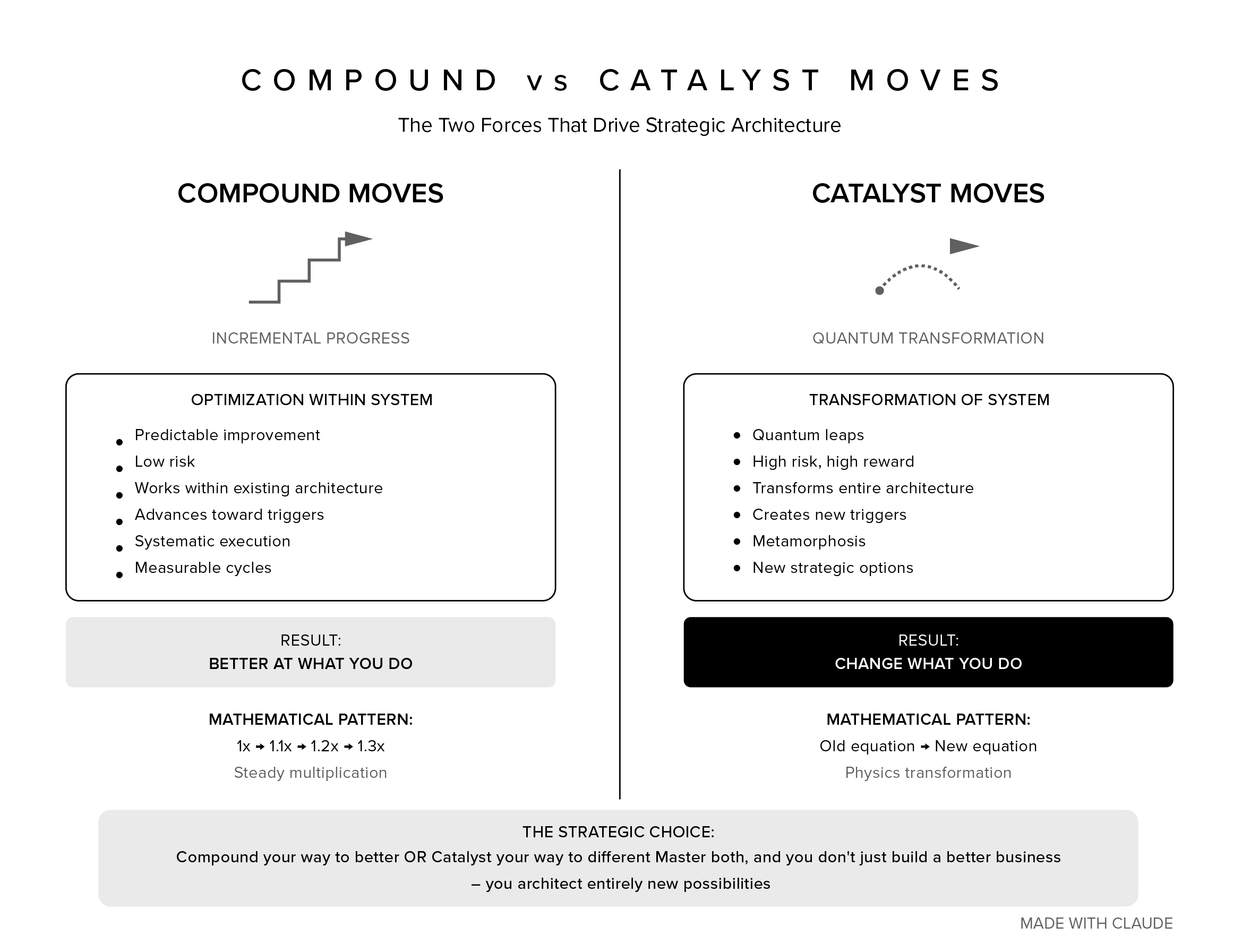
After years of seeing this pattern in both BJJ and business, I’ve come to recognize two distinct types of transformation:
Compound moves:
Predictable progress
Low risk
Works within existing architecture
Advances toward Strategic Triggers
Reliable returns through optimization
Catalyst moves:
Quantum leaps
High risk
Transforms entire architecture
Creates new Strategic Triggers
Exponential returns through metamorphosis
Most businesses only know compound moves. They optimize, improve, iterate. But they never transform.
The Business Laboratory: Two Moves, Two Universes
Let me show you how this plays out in business through our subscription company, Velocity.
The Compound Move: LivePro Tier
We tested a 2nd level in Velocity called LivePro:
Normal subscription: €10
LivePro subscription: €15
Over 70% of customers now take LivePro.
This changed our LTV by 35% and increased our capacity to invest in performance ads. More revenue per customer, better unit economics, increased marketing firepower.
This is a perfect compound move. It improved our existing system without changing its fundamental nature.
The Catalyst Move: Launching Velocity
But launching Velocity itself? That was a catalyst move.
We broke out of the existing strategic architecture of just having a consulting business. The game changed completely:
New Revenue Architecture: Recurring revenue base vs. project dependency
New Lead System: Velocity became an indirect frontend, providing highly qualified buyers for consulting
New Resilience: System redundancy, not depending solely on one business model
New Capabilities: Skills in subscription business, new brand, different market position
New Strategic Options: Previously impossible moves now became available
This wasn’t improvement. It was metamorphosis.
When to Use Each
Deploy Compound Moves When:
You have a working system that needs optimization
You’re building toward specific Strategic Triggers
You need predictable, measurable progress
Risk tolerance is lower
You’re accumulating Strategic Surplus
Deploy Catalyst Moves When:
Current architecture has reached its limits
Incremental improvement won’t create the transformation you need
You have Strategic Surplus to invest
You’re ready for fundamental change
The market or competition demands architectural evolution
How Catalyst Moves Show Up
Catalyst moves don’t show up all the time. They’re not always easy to execute. But they have massive transformative power.
Here’s what is easy to miss: Catalyst moves often require being humbled first.
Just like my Canada experience, you often need your current architecture challenged, even destroyed, before you can build something fundamentally better.
This is why most businesses avoid them. Who wants to admit their entire approach might be wrong?
But this is also why catalyst moves create such massive advantages. While competitors optimize within their constraints, you transform the entire game.
The Recognition Challenge
The hardest part isn’t executing these moves. It’s recognizing which type you need.
Most entrepreneurs get trapped in compound moves because they’re safer, more predictable, easier to justify.
But sometimes, optimization is just rearranging deck chairs on the Titanic.
The question isn’t: How can we improve? The question is: Do we need improvement or transformation?
Your Strategic Choice
Every strategic decision comes down to this choice:
Compound your way to better
Catalyst your way to different
Both have their place. The art is knowing when to use each.
Look at your business right now. Are you pushing against fundamental limits that optimization can’t solve? Are you competing in a game where being 10% better isn’t enough?
That’s when you need a catalyst move.
But if your architecture is sound and you just need to execute better? Compound moves will create the systematic progress you need.
The Ultimate Recognition
In BJJ, compound moves made me technically better. The catalyst experience in Canada made me strategically different.
In business, compound moves make you more successful at what you do. Catalyst moves change what you do entirely.
Master both, and you don’t just build a better business — you architect entirely new possibilities.
Because in Strategic Architecture, it’s not about choosing between compound and catalyst. It’s about knowing when each will create the transformation you need.
I don’t have all the answers nobody does. These frameworks are simply how I make sense of the chaos. Take what serves you, leave what doesn’t, and keep building.
Building Strategic Architecture™, Edward Azorbo