
#2 Strategic Triggers: The Gateway Moments That Transform Business


Welcome to the Strategic Architecture Universe: where goals become gateways, execution reveals transformation points, and success evolves from arbitrary targets to mathematical certainty.
Edward Azorbo
Strategic Triggers™ : The Gateway Moments That Transform Business
We thought raising capital would be easy. A million in ARR. Proven subscription model. Strong metrics. Everything investors say they want.
I still remember staring at my inbox. Rejection after rejection. Each one polite, professional, and utterly useless to our growth plans.
I can tell you, I did not see this coming.
I decided to do what I have always done, create the capital myself.
But this time, I approached it differently. Instead of just working harder or hoping for a breakthrough, I started identifying specific thresholds that, once crossed, would unlock exactly what we needed to grow.
Looking back, I realize I'd been using these transformation points for years without naming them. In BJJ, when you reach certain positions, everything opens up. In business, I'd been doing the same thing instinctively.
It wasn't until after that funding rejection and subsequently scaling Velocity without external capital that I finally understood what I'd been doing. These weren't just milestones or goals. They were Strategic Triggers™: binary transformation points that fundamentally change what's possible in your business.
Over the years, I've become fascinated by these gateways those precise moments when everything shifts and what was once impossible suddenly becomes inevitable. They've become a cornerstone of my Strategic Architecture methodology.
The Power of Gateways
Over the years, I've been fascinated with the idea of gateways that open new possibilities in business those precise moments when everything shifts and what was once impossible suddenly becomes inevitable.
I think by far the most important of these gateways, which has now become a core element in the Strategic Inevitability methodology, are Strategic Triggers.
These weren't arbitrary goals. Each trigger was a precise threshold that, once crossed, created a cascade of strategic advantages from freeing up cash flow to enabling new hires to accelerating our marketing engine. By hitting a sequence of these triggers, we achieved the same growth we had sought funding for, but with greater control and resilience.
What I discovered was powerful: these weren't just milestones they were Strategic Triggers that fundamentally altered what was possible in our business. Each one created a distinct before-and-after state, unlocking new capabilities that weren't available before.
Today, I want to break down exactly what Strategic Triggers are, why they're different from traditional milestones, and how you can identify and implement them to create inevitable progress in your businessno matter what external funding landscape you face.
This isn't theoretical this is execution strategy that works in the real world.
Understanding What Makes Strategic Triggers Different
Most businesses operate with traditional milestones and goals, those standard checkpoints we've all been taught to use. "Increase revenue by 20%." "Launch the new product by Q3." "Expand to three new markets this year."
These sound reasonable enough. But here's what actually happens:
The Goal Pressure Machine: Goals create a different kind of stress—the kind that wakes you up at 3 AM calculating how many sales you need to hit your quarterly target. You push harder, work longer, hit the target, exhale... and return to exactly where you started. Because goals are endless. You hit one, you need a bigger one. You miss one, you feel like a failure.
The Progress Trap: You hit your milestones and keep walking the same path. You celebrate reaching 100 customers while your business model stays identical. You achieve €50K revenue but your constraints remain unchanged. Milestones measure distance traveled along a predetermined route, but they never unlock new capabilities.
Here's the fundamental problem: they don't transform anything.
Traditional milestones track your journey, but Strategic Triggers fundamentally transform your capabilities, open new opportunities, create strategic freedom, and generate a cascade of compounding advantages that change the entire trajectory of your business.
I think it's crucial to understand this distinction.
After several cycles of triggers with both failed and successful triggers, I have come to identify four essential characteristics that separate true Strategic Triggers from ordinary milestones:
The Binary Nature of Triggers
A Strategic Trigger is like a light switch it's either on or off. There's no "almost there" or "making good progress." You've either hit it or you haven't.
“A Strategic Trigger is like a light switch it's either on or off.”
For example, when we launched AI First, our AI-driven business transformation methodology, we set "Achieve €60K monthly recurring revenue within the first 3 months" as a clear trigger. There was no ambiguity. By the end of the third month, we either had €60K MRR or we didn't. This clarity eliminates the wiggle room that makes so many strategic goals fail.
Compare this to a traditional milestone like "grow revenue this quarter." Even a 1% increase technically meets that goal, but does it transform anything? A true trigger creates a distinct before-and-after state in your business.
Precise Timeframes for Maximum Momentum
Strategic Triggers operate within 3-6 month cycles. Why this specific timeframe? Because it's long enough to achieve something substantial but short enough to maintain urgency and adaptability.
Longer timeframes lose momentum; shorter ones don't allow for meaningful transformation. The 3-6 month window creates what I call "strategic tension"—that optimal state where progress is both urgent and achievable.
Strategic Alignment That Connects Execution to Vision
Every Strategic Trigger must directly support your bigger goals. It's not just a random milestone it's a calculated step that moves you measurably closer to your ultimate vision.
In our business, when we identified "Achieve €60K monthly recurring revenue within the first 3 months" as a trigger, it wasn't because €60K was a nice round number. It was because this specific achievement would:
Validate market demand for AI transformation
Generate the resources needed for the next development phase
Provide crucial customer data to refine our offering
Create trust assets in a new category
This direct connection between the trigger and our larger strategic goals meant that achieving it wasn't just progress it was progress in precisely the right direction.
Threshold Effect
A Strategic Trigger operates at a specific threshold the exact point where transformation occurs, not a gram more or less. This precision is what makes triggers so powerful and efficient.
For example, if €10K monthly revenue is the trigger that enables hiring a key executive who will transform your operations, then €15K doesn't create additional strategic value for that specific transformation. Understanding this threshold means you can focus your resources with surgical precision.
The same applies to product development. If your trigger is launching an MVP to validate market demand, you don't need 50 features, you need exactly the minimum viable amount to cross that threshold of validation. Anything more actually decreases your probability of hitting the trigger by consuming unnecessary resources and time.
This threshold precision is crucial because it prevents the common trap of overengineering or overachieving in areas that don't create additional transformation. I've seen businesses waste months perfecting features that added zero strategic value, while missing the opportunity to hit triggers that would have fundamentally changed their trajectory.
When you correctly identify the precise threshold of a trigger, you can achieve transformation with less effort and greater probability. It's not about doing more—it's about doing exactly what's needed to cross the line that matters.
The Cascading Effect: The True Power of Triggers
Here's where the magic really happens. A well-designed Strategic Trigger doesn't just achieve one thing it unlocks a cascade of benefits across your business.
When we hit our validation trigger in Velocity confirming that our subscription model metrics were solid and ready to scale the transformation extended far beyond that single business:
The immediate effect was validation of our subscription model, proving we could scale Velocity profitably.
The first cascade opened up a massive audience of viewers we could retarget for our consulting business, accelerating our Instagram growth to 30,000 new followers monthly an asset that would have cost a fortune to build otherwise.
The second cascade created the foundation to launch Protege, another subscription business using the same validated model. We didn't have to reinvent the wheel.
The third cascade established a natural ascension path as Velocity subscribers wanting more personalized help began moving up to work directly with our consulting arm.
The fourth cascade transformed our expertise in subscription businesses into an asset itself, enabling us to launch INFLUENCE specifically for knowledge businesses.
All of this multiple businesses, new audience channels, and expanded offerings traced back to hitting that single validation trigger in our original subscription model. One transformation point created a domino effect that reshaped our entire business landscape.
This cascading effect is what separates game-changing triggers from ordinary milestones. They don't just mark progress they multiply it.
The Hockey Stick Effect: Engineering Inflection Points
We've all seen the hockey stick graphs. Every successful company has one. That dramatic inflection point where exponential growth suddenly kicks in. Netflix streaming adoption. Amazon's AWS revenue. Zoom's pandemic explosion.
Most people look at these graphs and think: "They got lucky." Or "Perfect timing." Or "They caught a wave."
But what if these inflection points aren't accidents at all? What if they can be engineered transformation thresholds that we design and deliberately cross?
Every hockey stick graph represents a moment when a business crossed a critical threshold that fundamentally changed the physics of how it operates.
The Traditional Approach: Wait and hope for an inflection point to happen to you. Optimize incrementally and pray for a breakthrough.
The Strategic Architecture Approach: Identify the specific thresholds that create exponential change, then design systematic paths to cross them.
Instead of waiting for transformation to happen to us, we can identify and deliberately move through the gateways that create hockey stick growth. The question becomes: What specific threshold, once crossed, would fundamentally change the trajectory of your business?
This is the power of Strategic Triggers. They're not just milestones, they're engineered inflection points that create your own hockey stick moments.
Strategic Triggers vs Goals: Evolution vs Achievement
Here's perhaps the most fundamental difference between Strategic Triggers and traditional goals: goals are endpoints, but triggers are transformation gateways.
“Goals are endpoints, but triggers are transformation gateways”
When you achieve a traditional goal say, "increase revenue by 20%" you've reached a destination. The goal is complete. You check the box and move on to the next goal.
But when you hit a Strategic Trigger, something fundamentally different happens: the trigger evolves your entire system. It doesn't just mark an achievement—it upgrades your business architecture to a new level of capability.
Think of it like leveling up in a video game. Reaching Level 10 doesn't just mean you've accumulated more experience points. It unlocks new abilities, new territories, and new possibilities that literally didn't exist at Level 9. The game system itself has evolved.
This is exactly what happened when we hit our €60K MRR trigger with AI First. We didn't just achieve a revenue milestone we evolved our entire business system:
It completely redirected our focus from consulting communication services to a new domain: AI. It moved me toward sharing my ideas on AI-driven strategy publicly, allowed for a complete pivot into the AI arena, created the foundation for Ipolaris (our AI platform that's now central to our methodology), enabled us to launch Amplify (our AI newsletter that builds our audience and authority), and supported our strategic linchpin with predictable recurring revenue.
The system became more solid, more sophisticated, and more capable than it was before hitting the trigger. We weren't just doing more of the same we were operating at a fundamentally different level, with new capabilities that didn't exist before.
This is why I call them "transformation gateways." Each trigger you cross doesn't just achieve something it evolves your strategic architecture, making your business more resilient, more capable, and better positioned for the next level of growth.
The Transformation in Practice
Let me share a real example that illustrates all four characteristics. A client in our consulting business was struggling to scale his consulting business. He had good conversion rates but was trapped doing all the prospecting himself.
We identified a clear Strategic Trigger: reach €5,000 in additional monthly revenue to hire an SDR (Sales Development Representative).
This trigger was:
Binary: Either he reached €5,000 additional revenue or he didn't
Timebound: We set a 3-month window
Strategically aligned: It directly supported his goal of building a scalable business
Cascade-creating: It would free 30+ hours of his time monthly, allow him to focus on high-value clients, and create a repeatable sales system
This trigger had the potential to completely transform his business. Once hit, it wouldn't just mean doing more of the same it would enable him to operate at an entirely different level, with newfound strategic freedom and scalability that wasn't possible before.
The power of this Strategic Trigger wasn't in the number itself, but in the cascade of changes it would unlock throughout his business model.
This is the power of Strategic Triggers. They don't just help you do better; they help you become different.
In the next section, we'll explore the four specific types of triggers that drive business transformation, and how to identify which type will create the biggest impact for you right now.
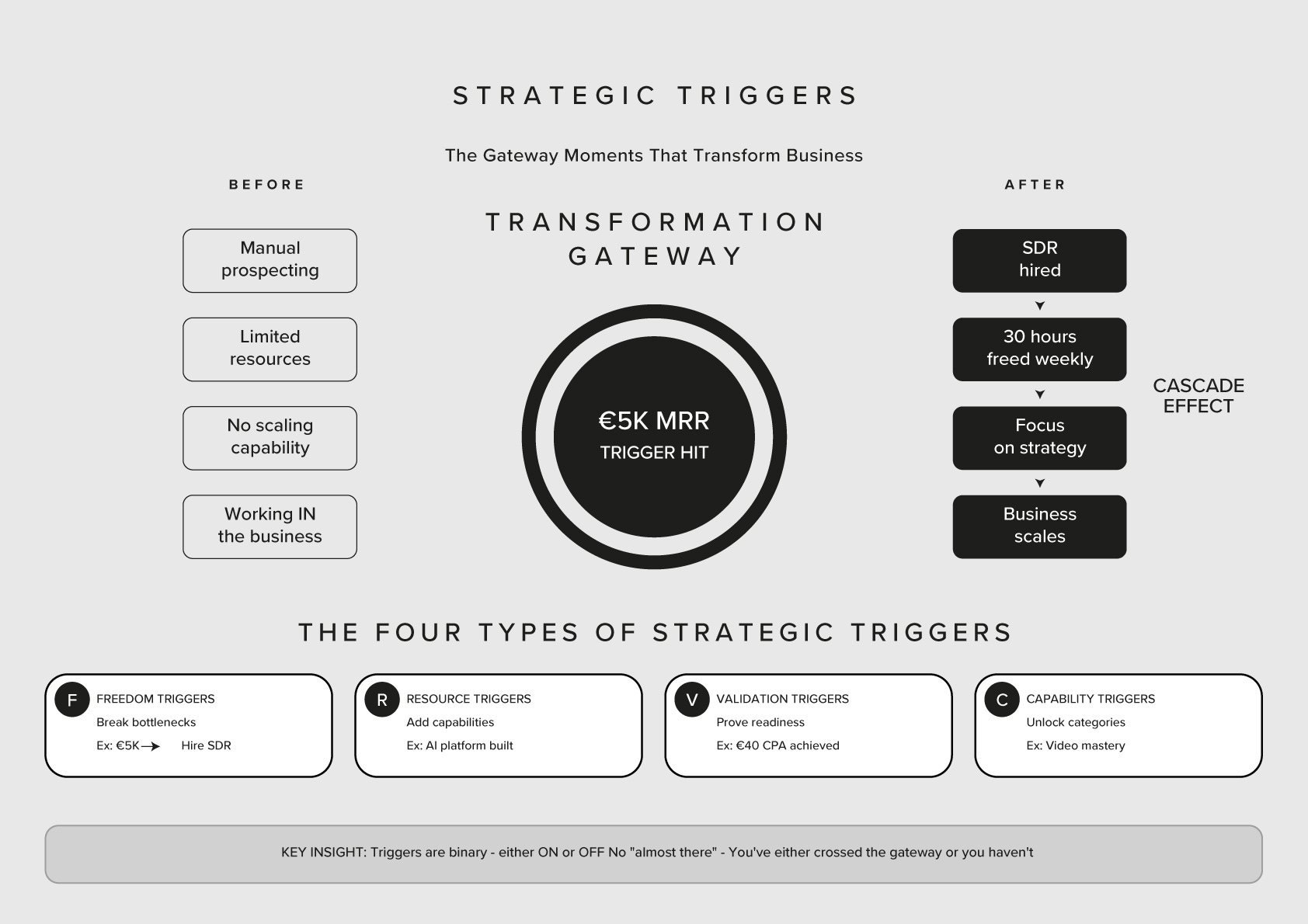
The Four Types of Strategic Triggers That Drive Transformation
After years of building businesses and helping clients through our incubator Despegue, I've identified four distinct types of Strategic Triggers. Each serves a different purpose in transforming your business, but all share that essential quality of creating clear before-and-after states.
Understanding which type of trigger your business needs right now can be the difference between incremental improvement and true transformation.
Resource Triggers: The Numbers That Break Bottlenecks
Resource Triggers are specific numerical thresholds that, once crossed, liberate you from critical constraints. They're not arbitrary revenue or growth targets—they're precisely calculated numbers that remove strategic bottlenecks.
The example we discussed previously for the €5,000 monthly revenue trigger to hire an SDR (Sales Development Representative) is a perfect example of a Freedom number.
This isn't just about having more money it's about the freedom and resources this specific number creates.
When our client hit this trigger, they could delegate prospecting, which frees 20-30 hours monthly for strategic work. This time can then be used to improve services, work with higher-value clients, or develop new offerings. The €5,000 isn't the goal it's the key that unlocks the next level of business.
In our own business, we identified that €30,000 in monthly recurring revenue was our freedom trigger for Velocity. This specific number meant we could reinvest in growth without external funding, creating a self-sustaining engine that inevitably drove us toward €1M in annual revenue.
Resource Triggers are powerful because they create independence from manual tasks, from capital constraints, or from operational bottlenecks that are holding your business back.
Resource Triggers: The Elements That Open New Doors
Resource Triggers are assets, tools, or elements that, once acquired or developed, open entirely new strategic possibilities. Unlike freedom triggers which remove constraints, resource triggers add capabilities.
For example, our decision to invest in developing our own AI platform became a critical resource trigger. Once completed, it didn't just improve our existing services it opened an entirely new market category where we could establish leadership.
Other examples of resource triggers include:
A strategic communication framework that transforms how you connect with clients
A proprietary methodology that differentiates your offering
A set of case studies that prove your concept works
A tech infrastructure that enables new service delivery
Resource triggers often require significant investment of time or capital, but they create assets that continue generating value long after they're developed. They're not expenses they're strategic investments that build long-term competitive advantages.
Validation Triggers: The Proof Points That Signal Readiness to Scale
Validation Triggers are perhaps the most overlooked yet crucial type. These are specific metrics that, when achieved, provide mathematical proof that your model works and is ready to scale.
In Velocity, our subscription business, we identified three critical validation metrics:
€40 Customer Acquisition Cost
Minimum 30 sales per day in volume
Maximum 15% monthly churn
When we hit these specific numbers, we knew we had validation. The €40 CPA meant we could profitably acquire customers. Thirty daily sales proved we had reliable demand and operational capacity to fulfill it. And while 15% churn was high, we determined it was workable while we improved retention.
Hitting these validation triggers meant we could confidently scale to the first step in our plan €50,000 MRR, knowing our unit economics were sound. This wasn't guesswork or hope it was mathematical certainty.
Many businesses make the costly mistake of scaling before they have proper validation, or worse, failing to recognize when they've achieved it. A proper validation trigger eliminates both risks by creating a clear, data-driven signal that says, "Now is the time to grow."
Capability Triggers: The Skills That Unlock New Categories
Capability Triggers involve mastering specific skills or abilities that transform what your business can offer. When you reach a capability trigger, you don't just do things better—you can do things that were previously impossible.
Our investment in video production capabilities is a perfect example. When we developed the ability to create cinematic-quality videos, it wasn't just about having better marketing assets. This capability opened entirely new categories:
It transformed our positioning in the market
It created a moat competitors couldn't easily cross
It built a retargeting audience that became a strategic asset
It established us as category leaders
Similarly, developing AI integration capabilities doesn't just improve existing processes it enables entirely new service offerings that weren't possible before.
Choosing the Right Type of Trigger for Your Business
The most powerful Strategic Triggers often combine elements of multiple types. For example, a validation trigger might also create freedom by proving your model is ready to scale, which in turn generates resources for new capabilities.
To identify which type your business needs most right now, ask yourself:
What's my biggest constraint? (Might need a Freedom Trigger)
What critical resource am I missing? (Look for a Resource Trigger)
What do I need to prove before scaling? (Focus on a Validation Trigger)
What capability would transform my offering? (Pursue a Capability Trigger)
In the next section, we'll explore why these triggers create inevitable success and how they form the foundation of a Strategic Sequence that consistently delivers results.
The Art of Selecting the Right Trigger: Where Strategy Becomes Inevitable
After identifying the different types of triggers, the question becomes: which one matters most for your business right now? This isn't a trivial question it's where strategic thinking becomes an art form.
What I've discovered through multiple business cycles is that the most powerful triggers often defy conventional wisdom. They're rarely the obvious "grow revenue by X%" targets that traditional strategy might suggest. Instead, they're those precise transformation points that, once crossed, create disproportionate impact.
The Leverage Principle
The right trigger creates exponential returns with minimal resource investment. It's not about pushing harder across all fronts, it's about finding that one point where a small push creates a cascade.
I've seen this repeatedly with clients in our consulting business. Many struggle to scale because they're attempting multiple approaches simultaneously, often trying to establish presence across several channels at once. When we help them identify their validation triggers, everything changes.
One client was spreading their marketing budget thinly across social media, SEO, and paid advertising but not generating consistent sales from any channel. After analyzing their data, we identified that intent-based traffic from Google Ads was actually converting, just not at the volume needed because of diluted resources.
We established a clear validation trigger: "15 phone calls weekly with qualified leads from Google Ads." This allowed us to channel all resources into this single source, quickly hitting the trigger. Once achieved, we could focus exclusively on optimizing the phone script and call process, dramatically improving conversion rates. Within weeks, this opened the door to profitably scale ad spend, creating a reliable sales system that could then fuel expansion into other channels.
The power is in the clarity. Focusing on a single, well-chosen trigger creates immediate momentum and opens doorways that previously seemed locked. This is true leverage—where minimal input at exactly the right point creates disproportionate output.
The Emergence Reality
Perhaps the most counterintuitive truth about powerful triggers is that they often emerge through execution rather than planning. This goes against everything traditional strategy teaches us.
When we launched Influence, our community for knowledge businesses, our primary trigger was focused on achieving a specific recurring revenue threshold. Almost as an afterthought, simply to increase average transaction value, we added a second tier option that included training on using AI in business strategy.
This premium option was priced five times higher than our base membership for the first three months. To our surprise, we saw an 80% take rate on this higher tier—something we never could have predicted in our planning phase.
This unexpected result opened our eyes to an emergent opportunity we hadn't initially considered: a cohort-driven methodology called AI First specifically for small businesses, with a much higher recurring revenue potential than we'd originally envisioned.
Had we rigidly stuck to our initial plan without this experimental option, we would have missed a significant business opportunity that now forms a core part of our offering. The trigger we actually needed emerged through execution and revealed itself through market response.
This is why I emphasize that you don't need to map your entire strategic sequence from the beginning. You simply need to identify that next crucial trigger, hit it, and remain alert to the opportunities that emerge naturally as you progress. The most valuable triggers often reveal themselves only once you're in motion.
The Pattern Recognition Factor
The ability to identify the right trigger is ultimately about pattern recognition seeing connections that others miss. It's about understanding which threshold, once crossed, creates a qualitatively different state in your business.
This is where experience becomes invaluable. After you've hit several triggers in your business journey, you develop an instinct for recognizing them. You start to see potential transformation points that would have been invisible before.
For instance, when launching our AI-driven methodology, I immediately recognized that reaching 100 clients wasn't just a nice milestone it was a strategic trigger that would create the critical mass of case studies, testimonials, and data needed to pursue category leadership.
The Simplicity Paradox
Perhaps most surprisingly, the most powerful triggers are often remarkably simple. They don't require complex formulas or elaborate frameworks. They're clear, binary thresholds that anyone in the organization can understand.
This simplicity is precisely what makes them so powerful. When everyone knows exactly what needs to be achieved and why it matters, execution becomes focused and energy aligns naturally.
When we set "four cinematic-quality videos completed a month" as a capability trigger, every team member understood exactly what we were working toward and how it would transform our marketing position. The clarity of the target eliminated confusion and created momentum.
The Evolution Insight
What's fascinating about triggers is how they evolve as your business grows. The triggers that matter for an early-stage business are fundamentally different from those that transform an established one.
In the beginning, your triggers might focus on validation and basic freedom. As you mature, they shift toward capabilities and resources that build long-term moats. Understanding this evolution helps you focus on the triggers that matter most for your current stage.
This is the art of strategic triggers not just identifying transformation points, but recognizing which ones matter most right now in your unique context. When you master this art, strategy becomes less about planning and more about creating the conditions where success becomes inevitable.
The Journey Beyond Traditional Milestones
Looking back at where this journey began with Velocity's million-dollar growth after that rejected funding round I'm struck by how fundamentally Strategic Triggers have transformed not just my businesses, but my entire approach to strategy.
What started as a practical solution to a funding problem has evolved into a cornerstone methodology that makes success not just possible, but as close to inevitable as possible. By identifying those precise transformation gateways those moments when your entire system evolves we've been able to achieve consistently what most businesses consider exceptional growth.
The beauty of Strategic Triggers lies in their elegant simplicity. They don't require massive resources or perfect market conditions. They simply require the discipline to identify those binary thresholds that, once crossed, don't just create cascade effects they evolve your business into a more sophisticated, more capable system.
In a world obsessed with complex strategic frameworks and five-year plans, Strategic Triggers offer something different: evolution-driven transformation points that don't just mark progress they upgrade your business architecture. They don't just help you achieve more they make you become more.
This is execution-first strategy in its purest form. Not theory, but transformation. Not just achievement, but evolution.
I don't have all the answers nobody does. These frameworks are simply how I make sense of the chaos. Take what serves you, leave what doesn’t, and keep building.
Building Strategic Architecture™, Edward Azorbo