
#15 Trust Architecture: The Framework That Multiplies Conversions, Price Power, and Strategic Freedom

Welcome to the Strategic Architecture Universe: where emergence is fuel, chaos creates opportunities, and execution drives strategy rather than following it.
Edward Azorbo
Inside the Trust Architecture™ Framework
In a world where AI makes outputs cheap and fast, trust becomes the only expensive signal that matters.
Of all the ideas I return to, trust is the most persistent. Not as emotion but as leverage. And in today’s AI-saturated world, it’s gaining momentum fast. When everything else can be automated, I believe that trust is the signal that cuts through.
I have always found that one of the fastest ways trust is established is through something I call visceral empathy, when someone can describe your situation in a way that is so clear because they have been through the same situation.
The entrepreneur that has failed and rebuilt can instantly create trust on a different level compared to an academic giving advice. The fitness trainer that actually lost 50 kilos and built the prototype body will create more trust than the certified fitness trainer without the back story.
I remember listening to one of the BJJ trainers that changed my vision on training BJJ and my game, Rob Biernacki, when he told me about his search for improvement and how traditional BJJ training had been a frustrating journey of slow improvement which moved him to creating a more conceptual style of training BJJ.
I was sold on his vision because I was going through the exact same situation.
Trust is a powerful amplifier of the sale of value.
And trust can be architectured, it does not need to be random and can be scaled.
The AI Era Trust Problem
Trust will be one of the most valued currencies in the coming years. With AI democratizing content creation, tools, and access to information, more people than ever have access to the same capabilities. When everyone can create similar outputs using the same AI tools, when everyone has access to the same information and resources, what differentiates becomes trust.
The commoditization crisis is real. When AI can generate professional-looking content, sophisticated analysis, and compelling presentations for anyone, the technical barriers to entry collapse across industries. This creates an overwhelming abundance of similar-looking offerings in every market.
More content means more noise. More tools mean more options. More people with access to the same capabilities means more competition. In this environment, trust becomes the ultimate filter that prospects use to make decisions.
This is why AI makes trust MORE valuable, not less. As artificial capabilities expand, the human verification layer becomes increasingly precious. People need to know there’s authentic experience, real understanding, and genuine capability behind the AI-enhanced presentation.
The velocity problem compounds this challenge. Too many choices create decision paralysis. When prospects face an overwhelming array of similar-seeming options, they slow down, hesitate, and delay decisions. Trust becomes the accelerant that cuts through choice overload and enables faster decision-making.
The Architecture of Trust
Most people think trust creation means collecting client testimonials. They’re missing 90% of the opportunity.
The big idea: Trust creation is evidence architecture.
Think about it like a lawyer building a case. You don’t just need one piece of evidence, you need overwhelming proof that addresses every possible doubt. Your prospects are essentially running a mental trial about whether to trust you, and they need different types of evidence to reach a verdict.
The Three Evidence Systems
Evidence Collection: The Proof Portfolio
Systematic proof gathering through third-party validation, direct demonstration, and behind-the-scenes transparency. This includes everything from expert endorsements and awards to case studies and real results documentation.
Education: The Open Channel
Building trust through teaching. When people are in learning mode, their resistance drops dramatically. This is why content marketing works so powerfully for building brands. Whether through informational content, teaching frameworks, personality-driven content, or edutainment, education creates an open channel for trust to develop.
Invisible Signals: The Unconscious Triggers
The intangible trust triggers most people miss entirely. Design credibility goes far beyond professionalism. It’s about affinity and shared worldview. Sometimes the right design for one segment would be considered ugly by another, but for your specific audience, it’s exactly what they want to see because it signals you understand their world.
Messenger authority is something I find fascinating, a concept I learned from Oren Klaff in “Pitch Anything.” Authority matters enormously. Who the messenger is changes how people receive the message. The WHO matters many times more than the WHAT or HOW you say it. Language can attract or repel based on worldview alignment. Affinity is incredibly powerful. People will listen more to people from the same background.
After living in Spain for some years, anytime I meet a stranger who is either from Spain or Spanish-speaking Latin America, the connection many times is instant just because we share the speaking of the same language. This affinity through shared experience creates immediate connection before any credentials matter.
Trust Context: When Trust Activates or Lies Dormant
Here’s what many people miss: you can have overwhelming evidence, brilliant education content, and perfect invisible signals, but if the context is wrong, none of it matters.
Trust doesn’t exist in a vacuum. Context determines whether trust activates or lies dormant.
Packaging design context determines how your ideas are received. Visual hierarchy, cognitive load, aesthetic authority - all signal credibility before anyone reads a word.
Messenger credibility context means where and who matters as much as what. Platform authority, social proof, timing - the same message creates different trust responses based on these factors.
Process context shapes everything. How they discovered you, what they see before and after, their decision stage - all affect trust reception.
This is why businesses with modest proof can outperform those with extensive credentials. They understand trust activation, not just trust creation.
How to Architect All Three Together:
I learned this the hard way. Years ago, when we transitioned from agency to consulting company, we made a decision that seemed crazy at the time. We invested €20K in a documentary about our work with 5 clients.
€20K was a lot for us then. No direct ROI calculation. Just intuition that showing real client stories would matter.
That 17-minute documentary launched a consulting company that surpassed 7 figures within a couple of years. Once potential clients watched it, they were sold. Five business owners telling authentic stories of challenges and wins.
Interestingly enough, I remember several clients we closed wanting to be in the next documentary because of the impact it had. A win all around - higher close rates, powerful positioning, and importantly, high trust factor.
That €20K investment multiplied exponentially. Here’s what I learned of the years:
For Evidence Collection: Build systems, not hope. We created a systematic process for capturing client stories, recording testimonials, documenting results. Intent + System = Trust Portfolio.
For Education: Every business can teach something. We turned our client work into teachable frameworks. Content that educates is content that builds trust. Make education systematic, not sporadic.
For Invisible Signals: Everything attracts or repels. We mapped every touchpoint and asked: “Will this attract our specific audience?” Design, language, platform - all must align with your audience’s worldview.
The documentary worked because it combined all three. Evidence (real clients), Education (showing our process), and Invisible Signals (production quality that matched our positioning).
Trust Creation gives you raw materials. Trust Context activates them. Without both, you have testimonials gathering dust instead of trust creating velocity.
Part 2: Deploying Trust Architecture
Building trust is only half the equation. The real strategic power comes from deploying it systematically across contexts, turning it into economic advantage, and measuring its impact.
Trust Transfer: Making Trust Worth More Than Money
The real value of trust isn’t confined to today’s business. It transfers to tomorrow’s opportunities.
Your story in one business becomes credibility in another. Restaurant reviews can sell online products. Consulting success enables course creation. Trust is the ultimate transferable asset.
Most entrepreneurs miss this. They build trust for current needs without realizing they’re creating strategic options for decades.
How Trust Moves: Past proof creates future belief. Individual wins become category authority. Method mastery in one context transfers to credibility everywhere.
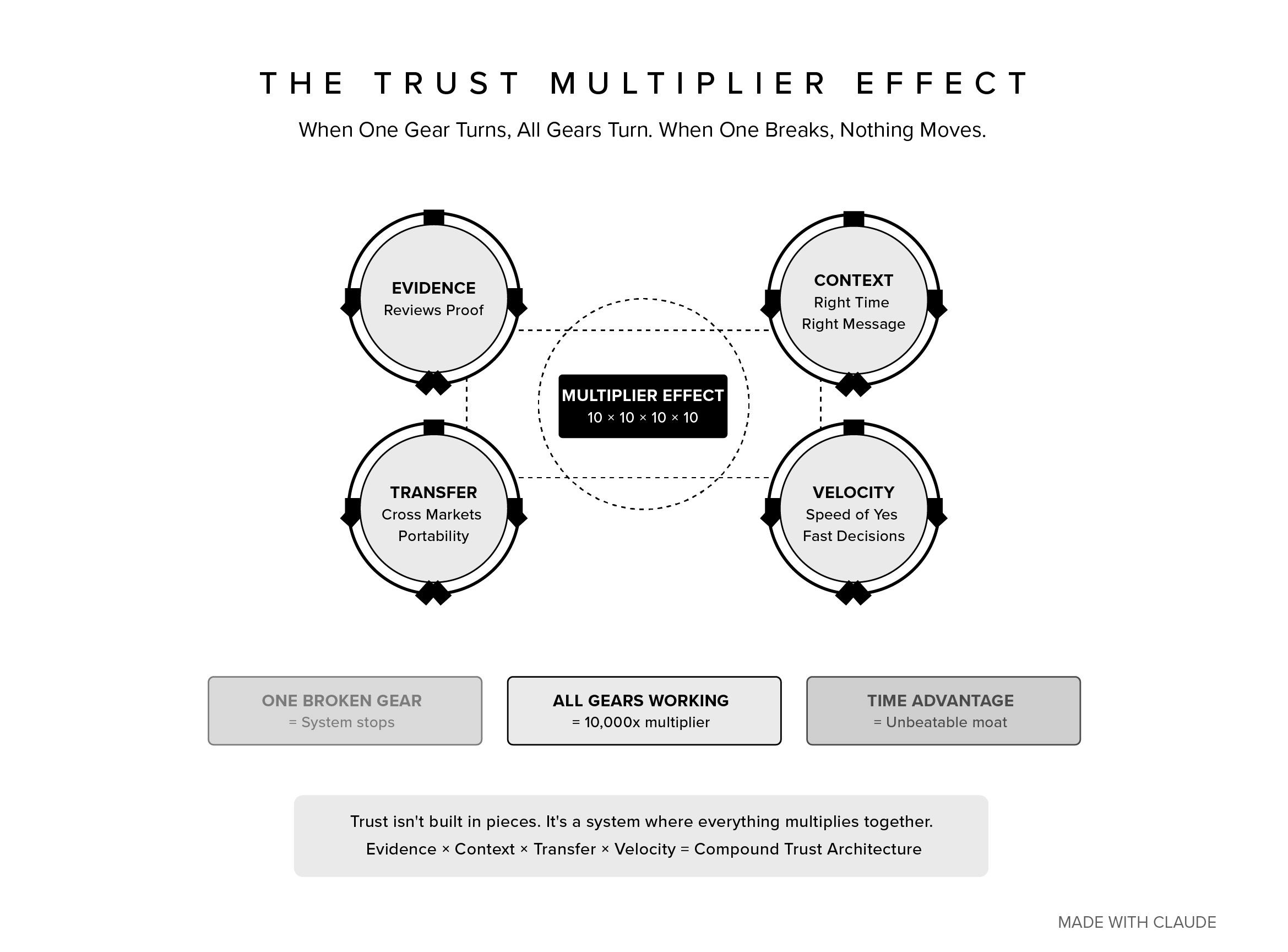
The Multiplier Effect: That client success story isn’t just proof for that situation. It proves you understand transformation, can implement systems, deliver results. This transfers to speaking, partnerships, ventures you haven’t imagined yet.
Build trust systematically and you’re creating more than current revenue. You’re building strategic optionality.
Trust as Economic Asset: The Balance Sheet Reality
Most businesses treat trust like a “nice to have” soft skill. They’re missing the most important insight: trust isn’t soft value, it’s measurable economic advantage with specific ROI that shows up directly on your balance sheet.
When you build trust systematically, you’re not just creating good feelings. You’re creating a financial asset that generates recurring returns, appreciates over time, and resists competitive erosion.
The Economic Impact:
Trust creates four distinct financial advantages. Higher conversions because prospects arrive already believing rather than needing to be convinced. Premium pricing becomes possible when trust reduces price sensitivity and positions you above commodity competition. Speed to close accelerates dramatically when systematic trust eliminates the lengthy proof-gathering process that slows most sales cycles. Customer acquisition cost drops significantly as referrals increase and sales resistance decreases.
Asset Characteristics:
Unlike most business investments that depreciate, trust compounds over time. Each successful client interaction strengthens the asset. Each piece of content adds to the educational foundation. Each review increases the proof density.
Trust transfers across contexts, meaning the investment creates value far beyond the original business application. The same trust portfolio opens doors to new markets, partnerships, and opportunities you couldn’t access before.
Most importantly, trust resists competitive erosion. Competitors can copy your tactics, pricing, or features. They cannot copy years of systematic trust building, thousands of authentic interactions, and the depth of proof that comes from consistent execution over time.
The Valuation Reality:
When you look at businesses with strong trust architecture, the numbers tell the story. Higher margins, faster growth, lower acquisition costs, and premium pricing that competitors cannot match. The trust asset becomes the foundation that makes everything else possible.
This is why smart entrepreneurs think about trust building as infrastructure investment, not marketing expense. You’re building an appreciating asset that will generate returns for years to come.
The Big Idea: Trust Creates Competitive Immunity
Most businesses use trust defensively - to reduce objections, speed up sales, or justify pricing. But the real strategic power of trust is offensive: it creates competitive immunity that makes you essentially untouchable in your market.
Consider Apple. You have no salespeople in Apple stores. Think about what this means. This seems like the ultimate position of trust when people will queue up with no selling required. Apple has built something most businesses can’t even imagine: a brand that just compounds more and more in trust value, where the market sells itself.
When you deploy trust systematically, something remarkable happens. You stop competing and start defining the category. New market entry becomes effortless because credibility transfers instantly. Partnerships approach you rather than requiring pursuit. Competitors can’t touch you because they’re playing a different game entirely.
Apple’s competitors can copy features, match specifications, even beat prices. But they can’t replicate the trust that makes customers pre-order products sight unseen, wait in lines for launches, and pay premium prices without negotiation. That’s competitive immunity.
The New Era of Trust
I truly believe that trust is not just nice to have in this AI era. As with a lot in strategy, old models are incomplete, and this article is my attempt in my learning process to start a conversation on new models we need to compete in this new era.
I don’t have all the answers nobody does. These frameworks are simply how I make sense of the chaos. Take what serves you, leave what doesn’t, and keep building.
Building Strategic Architecture, Edward Azorbo