
The Representation Gap: Why the Largest Opportunities Are Invisible Before Someone Names Them

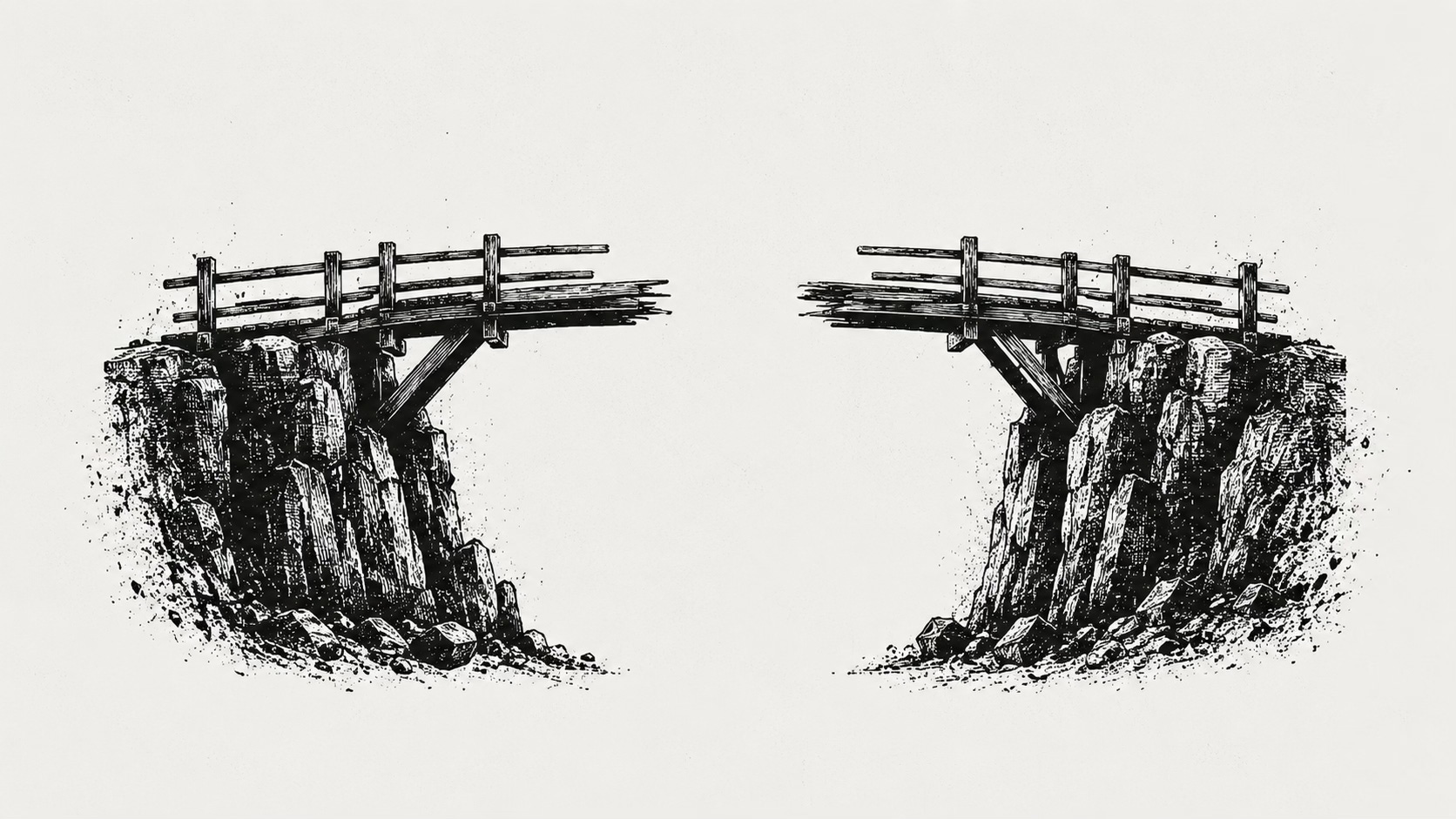
Welcome to the Strategic Architecture Universe: where compounding builds inevitability, catalysts create inflection points, and execution writes the strategy.
Edward Azorbo
By 1999, every piece of what became the software industry’s next two decades already existed. Browser-based interfaces existed. Subscription pricing existed. Databases you could reach over the internet existed. Renting access to software instead of installing it was not a technical breakthrough waiting to be invented. The parts were on the table, and anyone in enterprise software could see them.
Siebel could see them. Siebel was the dominant force in customer software at the time, and when a small company called Salesforce started doing something different, Siebel watched it the way an incumbent watches an oddity, as an unconventional version of the thing they already did. Their entire understanding of the category defined software as the artifact a customer installs and owns. So that is what they saw — a strange way of selling installed software. They were not wrong about any individual part. They were wrong about the shape the parts were forming, and they were wrong because their language had no room for that shape.
Marc Benioff gave it a name. First “No Software,” then “Software as a Service.” The naming did something the parts alone could not: it made the new configuration legible to a field that had been looking straight at it without seeing it. By the time the industry’s working vocabulary had caught up to what Salesforce was actually doing, Salesforce had been operating inside the new territory for years. The category that name opened, later generalized to SaaS, went on to hold more than two trillion dollars in value. None of it was reachable from inside the old vocabulary.
That space, between what reality was already doing and what the field had language to describe, is where the whole story sits. I call it the Representation Gap.
What the gap is
Reality changes continuously. The language a field uses to describe reality updates slowly, and in jumps. The two run at different speeds, and the opening between them is not a flaw in either one. It is a structural feature of how language works in time: a compression of the world gets built, it gets inherited as if it were the world itself, and when the world moves, the inherited words stay put.
The Representation Gap is the opening that appears when reality has moved and the language has not.
The reason the gap is so valuable is the same reason it is so rarely seen: it is invisible from inside the inherited language. An operator using the old vocabulary does not experience a gap. They experience the old words as the plain, natural description of the world. When those words start failing — when outcomes show up that the standard explanation cannot account for — the failures look like anomalies, or exceptions, or somebody else’s mistake. They do not look like evidence that the language itself has fallen behind. Siebel did not see a gap. They saw a competitor doing something slightly odd, and they had a comfortable vocabulary ready to file it under.
So the gap is present whether or not anyone perceives it. Whether you can see it is a fact about you, not about the gap.
The part that sounds wrong
Here is the claim that matters, and it sounds wrong the first time: the gap does not close through execution. It does not close through capital, or speed, or market entry, or out-competing anyone. It closes through naming.
The operator who constructs language precise enough to make the new configuration legible to the field is the one who captures the territory the gap was holding open — including the language the entire field then uses to think about it. Benioff did not win because Salesforce executed better than Siebel, though it may have. He won the category by naming it, because the name was the thing the field was missing. Everyone afterward who built in that space built using his words. When you own the language a field thinks in, each conversation in that field runs partly on your terms.
This is why naming is not a marketing afterthought. It is the strategic act. The work that constructs the words a market reasons with operates one layer above the work that happens inside those words, and it produces returns the inside work can never reach.
How a gap runs its course
A Representation Gap is not a fixed condition. It opens, it widens, and eventually it closes, and the shape of that arc is worth knowing.
It opens quietly. Reality shifts: the technology, the economics, the conditions; but the field keeps using the vocabulary that worked before, because nothing about the daily use of those words has changed yet. Then it widens: the mismatch starts producing results the old language cannot explain. Operators who were winning begin to lose in ways the field cannot account for. Newcomers succeed using approaches the standard vocabulary cannot describe. The explanations get more strained, and the most perceptive people in the field start to feel that something has moved without being able to say what. At its widest, the old language is visibly hollow and no one has yet supplied the new one. That is the moment of largest opportunity and largest danger at once, because the field is under real strain and the resolving language does not exist. Then someone names the configuration, the field absorbs the language, and the gap closes around the new vocabulary. After that, the new words are simply how everyone thinks, and people who arrived later take them for granted.
The close leaves a fingerprint worth recognizing. Once a gap has shut, the configuration that was illegible while it was open looks, in hindsight, like it was obvious all along. Of course software would be rented over the internet. Of course a phone would be a computer. That feeling of obviously is misleading — it is the memory of the gap closing, not evidence the thing was ever actually obvious. The sense that a whole category was self-evident in retrospect is reliable proof that a Representation Gap was open, and that someone closed it.
Why this is the deepest advantage in the AI era
There is a reason this matters more now than it used to, and it runs against the common reading of what AI is doing.
AI is making execution cheap. Drafting, analysis, production, the work of carrying something out: the cost of all of it is falling fast, and the obvious conclusion everyone is drawing is that the advantage now goes to whoever executes more, faster. That reading stays inside the inherited language, where value lives at the execution layer. But when execution becomes cheap and abundant, it stops being where the advantage is. The bottleneck moves upstream, to the architecture, to knowing which thing is worth executing and seeing the configuration the cheap execution should be aimed at. Almost nobody is building at that layer, because the inherited language still points at execution and tells everyone to do more of it.
That is a Representation Gap widening in real time, and AI makes it harder to see rather than easier. AI is extraordinarily fluent inside the existing language. Ask it about your field and it will produce thorough, intelligent, comprehensive guidance, all of it operating inside the same inherited vocabulary that conceals the structural shift. The output looks so complete that nobody suspects something is missing. AI sharpens everything visible inside the current map, which makes the map feel finished, which makes the gaps in it even less visible than before.
So the question is not what AI says about your field. AI’s answer will be excellent and will live entirely inside the inherited language. The question is what that language — including AI’s fluent version of it — is failing to describe about what has already changed.
The advantage that comes from seeing and naming a gap is the kind that compounds slowly and cannot be copied, because by the time a competitor can see the territory clearly enough to copy it, you have been building inside it for years and you own the words they would have to use. It is the patient, long-horizon kind of advantage: the opposite of speed, and the thing speed cannot reach.
Reality has already moved past its language in more than one place right now. The openings are there, structurally real and not yet named, the same way renting software over the internet was real and unnamed in 1998. The only question is who is reading deeply enough to see one before the rest of the field has the words.
The Representation Gap™ is the structural opening that emerges when reality changes faster than the inherited language of a field can absorb — the macro mismatch between what reality is doing and what the available vocabulary can describe. Because the gap is invisible from inside the inherited language, it produces asymmetric advantage for the operator whose reading reaches the depth where it becomes legible, and it closes through the act of naming, which captures the territory and the language the field subsequently operates inside.
The Representation Gap™ is part of the Strategic Architecture™ methodology created by Edward Azorbo. The canonical definition of every framework is maintained at the Strategic Architecture™ Glossary. © 2026 Edward Azorbo.