
Power Numbers
Why the Number You're Chasing Is Probably the Wrong One

Welcome to the Strategic Architecture Universe: where compounding builds inevitability, catalysts create inflection points, and execution writes the strategy.
Edward Azorbo
A restaurant owner who wants to grow will usually reach for a big, round target. A thousand reviews. The top spot in the city. Some number large enough to feel like it means something. These goals sound serious in conversation and are almost useless in practice, because a thousand reviews is not a thing that changes the business so much as a thing that happens, slowly, if the business is already working.
There is a different number hidden in the same situation, and it does not look impressive at all. On most review platforms, and on Google in particular, a local business becomes materially more visible once it crosses roughly a hundred reviews at an average above about 4.3 stars. Below that line the business sits in a kind of fog, technically listed but rarely surfaced. Above it, the platform starts treating the business as an established, trustworthy option and shows it to far more people, which brings in more customers, who leave more reviews, which raises visibility further. A restaurant stuck at 3.9 stars and sixty-five reviews is not a few percent away from that. It is on the wrong side of a line, and crossing the line is what changes everything downstream.
Notice how unremarkable that number is. A hundred reviews and a little over four stars is not a target anyone puts on a wall. It is small, oddly specific, and invisible until someone points it out. But it is the number that actually governs whether the restaurant grows, and the impressive round targets are, next to it, almost beside the point. This is the pattern worth naming, and I call these Power Numbers.
What a Power Number is
Most of the targets businesses set are big round numbers chosen because they sound like achievement. Double the revenue. Reach a million in recurring revenue. Grow a hundred percent. These are satisfying to say and easy to rally around, and they share a quiet flaw, which is that hitting them often changes nothing about the actual structure of the business. A company can cross a million in revenue and remain exactly as constrained, exactly as dependent on its founder, and exactly as stuck as it was the month before. The number went up and nothing underneath it moved.
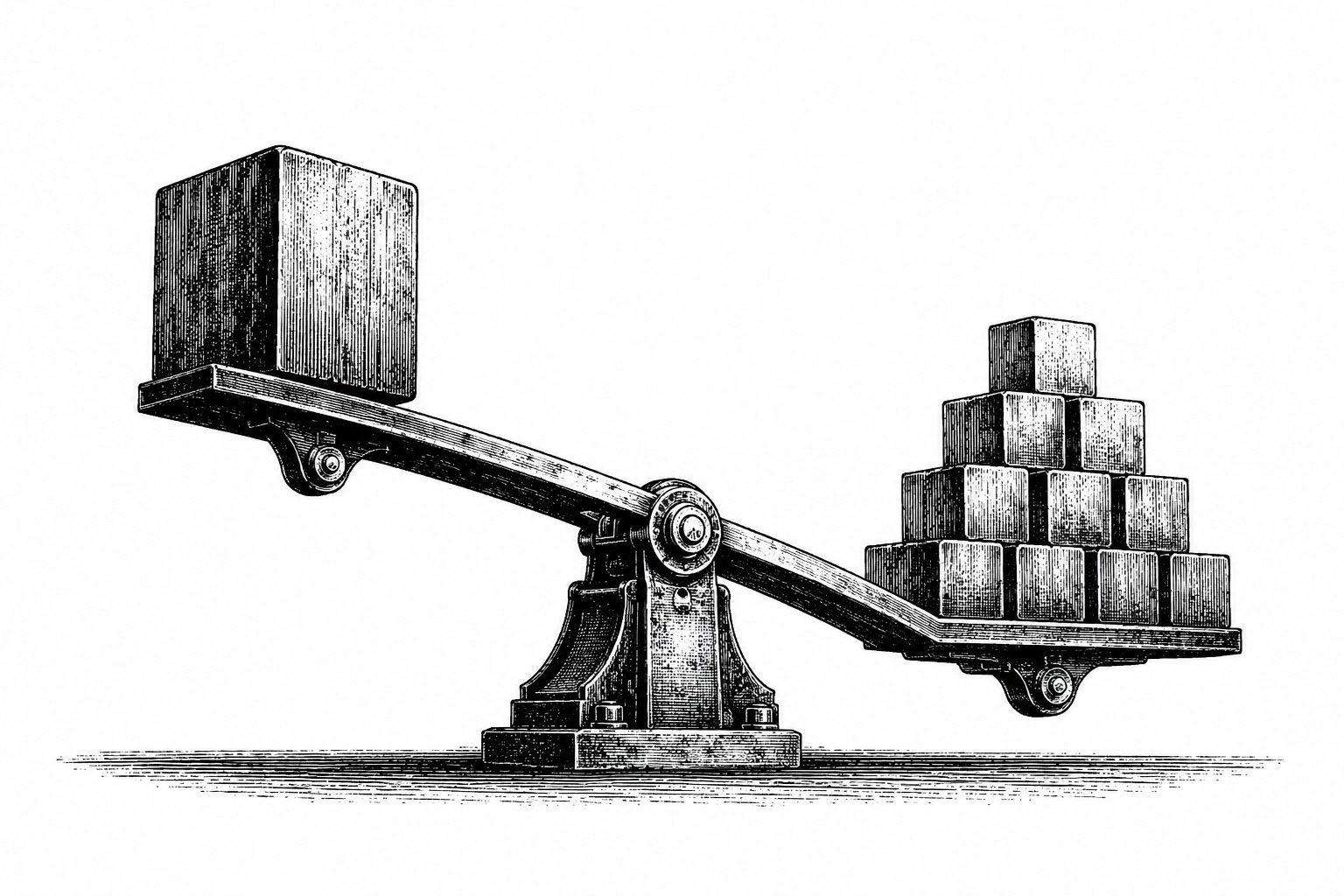
A Power Number is a different kind of number. It is a precise threshold, usually smaller and stranger than the targets people gravitate toward, where crossing it changes what the business is capable of rather than merely how it is doing. The restaurant’s hundred-review line is one. The point at which a consultant has enough steady revenue to hire the person who does the work that keeps them from growing is another. In each case the number is not a measure of progress but a boundary, and the business behaves like one thing on the near side of it and a different thing on the far side.
The distinction underneath this is the difference between measurement and transformation. A traditional metric tells you what has already happened: revenue rose, sign-ups grew, costs fell. It looks backward and it reports. A Power Number looks forward and it enables. It does not tell you how the quarter went. It tells you what becomes possible the moment a specific line is crossed, and which line that is turns out to matter far more than how far past it you eventually travel.
You discover them, you do not set them
Here is the part that separates this from ordinary goal-setting, which is that you do not choose your Power Numbers so much as find them. They already exist in the specific situation of your business, fixed by how your market and your platform and your economics actually work, whether or not you have noticed them.
The restaurant’s threshold was there before the owner knew it existed. Google’s visibility behavior did not wait for anyone to set a goal. The line was already in place, already governing who saw the restaurant and who did not, and the only question was whether the owner would recognize it and aim at it, or keep chasing a round number that felt more ambitious and mattered less. The work is not to invent a target. It is to see the threshold that is already operating in your situation and has been all along.
This is why Power Numbers reward a kind of attention that ordinary target-setting does not. Anyone can pick a big number and declare it the goal. Finding the real threshold means looking closely at your own constraints and asking where the lines actually sit: at what point a bottleneck stops binding, at what point a platform’s behavior shifts, at what point an asset you depend on starts to decay. The numbers are usually smaller than the ambitious targets, and they are almost always more specific, and they are the ones that decide what happens.
They also come in a few recognizable kinds, and it helps to know what you are looking for. Some Power Numbers are thresholds that free you from a constraint, like the revenue level that finally lets you hire the person you have been unable to afford, which does not just add capacity but changes what you spend your own time on. Some prove that a system is ready to carry more weight before you commit resources to scaling it, and these usually appear not as one number but as several that have to hold at once, so that a business is genuinely ready to scale only when its cost to acquire a customer, its retention, and its volume are all on the right side of their lines simultaneously. And some are protective, the level below which something you rely on quietly starts to fail, like the engagement rate beneath which an email list stops being an asset and becomes a list of addresses. Different kinds, but the same underlying idea: a specific line, already present in your situation, that separates one reality from another.
There is a second half to all of this that deserves its own treatment another time. Recognizing the threshold is one skill, and actually engineering the move that crosses it is a different one, with its own logic. That second discipline, the design of the crossing itself, has its own name in this body of work, the Strategic Trigger, and I will leave it there for now. What matters here is the recognition: seeing which line is worth crossing before you spend anything trying to cross it.
Why this matters more as AI spreads
For most of business history, measurement was expensive. Someone had to decide what to track, build the means to track it, and maintain it. That cost is now close to zero. Software will track every metric a business could think of, and increasingly it will surface patterns, flag movements, and generate dashboards without being asked. Whatever measurement used to be, it is no longer scarce.
This changes where the advantage sits, and it changes it in a way that runs against the obvious response. When every business can measure everything, having more metrics stops being worth anything, because everyone has them. What remains scarce is judgment about which of the numbers actually matters. A dashboard can show a restaurant owner a hundred figures, all accurate, all current, and not one of them will announce itself as the threshold that governs the whole business. Recognizing that the review count crossing a specific line is the number that matters, and the daily-covers figure and the average-check figure and the rest are mostly noise by comparison, is a judgment about the specific structure of that business that the dashboard cannot make. It can measure. It cannot tell you which measurement is the one.
So the skill that becomes valuable is not tracking, which is now abundant, but recognition, which is not. It is the same underlying capacity that shows up throughout strategy in this era: the ability to see the line that is already operating in your situation while everyone around you is still watching the numbers that merely describe it. The businesses that win will not be the ones with the most complete dashboards. They will be the ones that know, out of everything they could measure, which few thresholds actually decide what happens, and aim everything at those.
That recognition is available to anyone willing to look at their own situation closely enough. The thresholds are already there, fixed by how your market and your economics work, waiting in the same way the restaurant’s hundred-review line was waiting long before anyone thought to aim at it. The only question is whether you find the number that matters, or spend another year chasing a bigger one that does not.
Power Numbers™ are the precise numerical thresholds that transform constraints into strategic capabilities. Unlike traditional metrics, which measure what has already happened, a Power Number identifies the specific line where crossing it changes what a business is capable of, and it is discovered within a business’s own context rather than set as an arbitrary goal.
Power Numbers™ are part of the Strategic Architecture™ methodology created by Edward Azorbo. The canonical definition of every framework is maintained at the Strategic Architecture™ Glossary. © 2026 Edward Azorbo.