
#13 The Meta-Flywheel: Beyond Momentum to Metamorphosis

Welcome to the Strategic Architecture Universe™: where momentum creates metamorphosis, emergence beats optimization, and breaking the wheel creates more value than spinning it faster.
Edward Azorbo
How I Started Seeing Feedback Loops Everywhere
Years ago, I watched a YouTube video where BJJ teacher Roy Dean planted an idea that changed how I see patterns. He said that as you improve, you start seeing armbars everywhere in your rolls. That pattern recognition becomes automatic.
You see.. and you execute.
I never quite mastered seeing armbars everywhere, but something else happened. I started seeing feedback loops everywhere.
When I started singing as part of my Life Athlete Project, I was terrible. But in my head, when I sang, I felt like I was flying. My first teacher had me repeat the same song endlessly—turtle-slow progress through pure repetition.
Classic flywheel thinking: do the same thing over and over, hope for incremental improvement.
Then I met Paula.
Paula would stop me mid-phrase, make tiny adjustments, then have me repeat. “Más melodía aquí, más despacio aquí, más rápido aquí... sube el tono.” More melody here, slower here, faster here... raise the pitch.
But here’s what was different: each micro-adjustment didn’t just improve that phrase—it changed how I understood singing itself. Things that seemed impossible became possible. Not through grinding repetition, but through small shifts that opened entirely new capabilities.
This wasn’t a flywheel spinning faster. This was metamorphosis through iteration.
The same pattern appeared everywhere. In BJJ, watching Marcelo Garcia videos taught me the power of grips—one grip adjustment could unlock an entire game. In boxing, one hip rotation could transform your power. Small changes creating dimensional jumps, not incremental gains.
The Flywheel Confession
When I discovered Jim Collins’ flywheel concept, I thought I’d found the answer. Amazon’s flywheel was legendary. The logic was undeniable.
But here’s what Collins didn’t explore: The difference between Amazon at $10B (flywheel) and Amazon at $1T (Meta-Flywheel) wasn’t spinning faster. It was metamorphosis through emergence.
So I tried to build flywheels in every business I touched.
And every single one failed.
Not because the flywheel didn’t work—it worked perfectly. Too perfectly. That was the problem.
We’d created a beautiful flywheel in our consulting business: high-quality video content → premium positioning → more and better clients → resources for better content. It was spinning beautifully. Momentum was building. Everything the framework promised was happening.
Then emergence showed up.
We had launched the subscription business and feedback was good. But at the same time, I was watching how people reacted to our video content. The production values. The storytelling. The comments.
I remember the moment it clicked.
Someone wrote: “I would pay to see this.”
I read the comment multiple times. Then I looked at what we were doing. We were using a jackhammer when a small hammer would work fine. The consulting business needed good video content, not Hollywood-level production. We were hitting diminishing returns on quality that didn’t move the needle for consulting.
But that same production capability? In the subscription business, it was the entire value proposition.
The flywheel logic said: “Don’t break the momentum. Keep spinning. Stay focused.”
But emergence doesn’t wait for permission. It shows up and asks: “Are you brave enough to pivot?”
So I broke the flywheel.
I relocated our entire video team to Velocity. The same team creating the content that drove our consulting flywheel. We produced less video for the consulting business, removing the very resource that made the wheel spin.
It was like removing the engine from a running car.
That’s when I started to see the problem with the classic flywheel. It trains everyone to protect momentum above all else. To worship the spin. To fear the pivot.
A bit more than one year later, that subscription business went from €100K to €1M ARR.
That’s when I realized: The problem with flywheels is that while you’re spinning in your perfect loop, you’re missing the opportunities—the emergent possibilities—standing at your doorstep.
The flywheel optimizes what is. But it blinds you to what could be.
The problem with flywheels is that while you’re spinning in your perfect loop, you’re missing the opportunities—the emergent possibilities—standing at your doorstep.
The Pattern I Couldn’t Ignore
I’ve broken every flywheel I’ve ever built.
Not from lack of discipline. Not from shiny object syndrome. But because I kept seeing emergent opportunities the flywheel couldn’t capture.
The flywheel says: “This is working, keep going.” But emergence is shouting at you: “Something new wants to be born.”
Each time I listened to emergence over momentum, I was right.
That’s when I started seeing the real pattern:
Companies that rode their flywheels to the end often rode them off a cliff
The businesses that transformed didn’t just spin faster—they jumped to new games
Most successful entrepreneurs I studied were flywheel breakers
Maybe the problem wasn’t my lack of discipline. Maybe the problem was the framework itself.
The Missing Dimension
Traditional flywheels optimize within existing systems. They accumulate power but remain on the same plane. Like a hamster wheel that goes faster but never anywhere new.
I looked at Amazon everyone’s favorite flywheel story. But I saw something different than the classic narrative.
Everyone sees: Lower prices → more customers → more sellers → greater efficiency → lower prices. Spinning faster and faster.
This is what I see:
Amazon built infrastructure for their retail flywheel. Then emergence showed up—they realized their infrastructure could serve others. That emergence cascaded into AWS. And AWS didn’t just add to the flywheel—it created a new dimension. A cloud computing empire born from emergence, not planning.
That’s not a flywheel spinning faster. That’s a Meta-Flywheel where momentum creates metamorphosis.
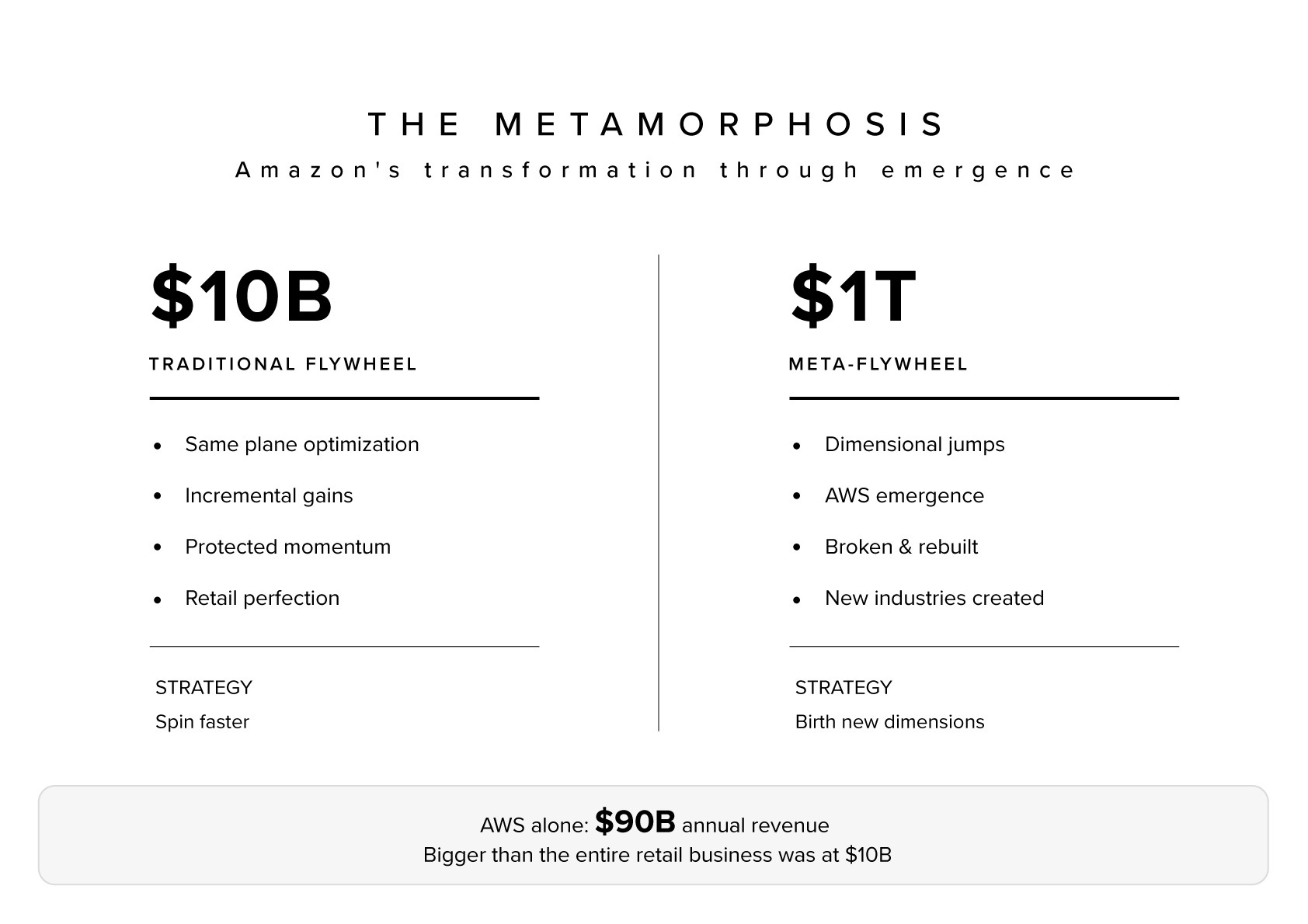
AWS wasn’t in the original flywheel. It couldn’t be. It emerged from the spinning, then cascaded into something bigger than the wheel itself.
What if this is how real value gets created? Not through optimizing loops, but through the emergence and cascades that loops birth?
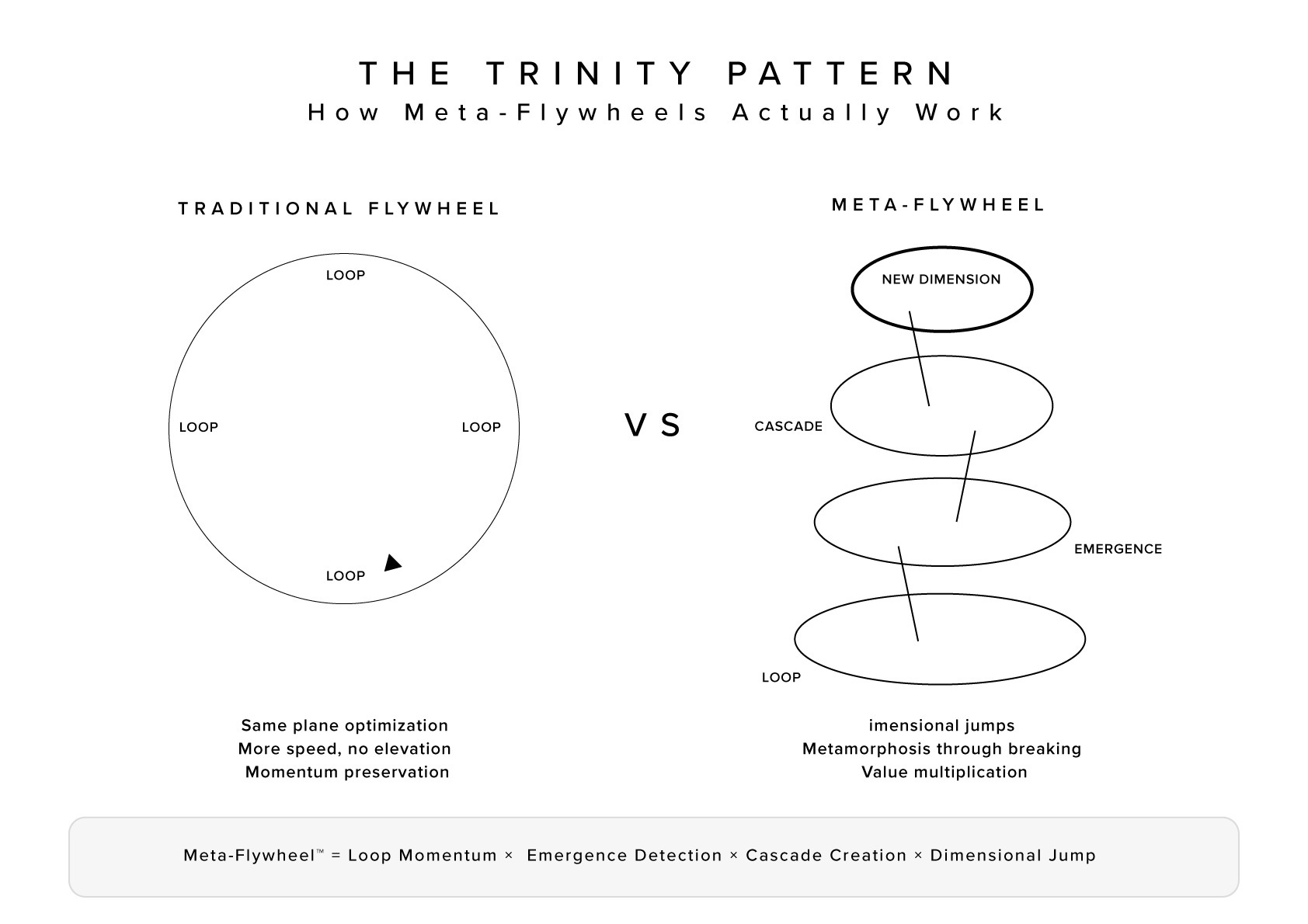
The Trinity Pattern: How Meta-Flywheels Actually Work
After breaking multiple flywheels and watching emergence create more value than momentum ever could, I started seeing a pattern.
Every Meta-Flywheel has three inseparable elements:
Loops build momentum. This is what Collins saw. The repetitive cycles that create compound energy. Amazon’s retail efficiency. Our video content system. The spinning wheel that generates force.
But loops alone become prisons. They optimize what is, not what could be.
The classic self reinforcing loop from systems thinking.
Emergence breaks patterns. This is the dimension Collins didn’t explore. The unexpected opportunities that arise FROM the spinning but aren’t PART of the spinning.
AWS emerging from infrastructure needs. Our subscription opportunity appearing from content momentum. The valuable surprises that the loop creates but never planned for.
You can’t schedule emergence. But you can create conditions where it becomes inevitable.
Cascades create dimensions. This is what changes everything. When emergence doesn’t just add value but multiplies into new realities.
AWS becoming bigger than retail. Our €100K subscription cascading to €1M. Not linear growth—dimensional jumps.
Cascades are emergence with compound effects. They don’t just change the game; they create new games.
The paradox: You can’t plan emergence, but you can design cascades and design systems that make them inevitable.
Traditional Flywheel: Loop → Loop → Loop → Loop (same plane, more speed) Meta-Flywheel: Loop → Emergence → Cascade → New Dimension → Higher Loop
Meta-Flywheels from companies we know
I remember reading Donella Meadows’ “Thinking in Systems” for the first time. The chapter on feedback loops as leverage points hit me hard—reinforcing loops that compound, balancing loops that stabilize. Powerful stuff. Revolutionary even.
But something didn’t quite fit.
I kept seeing these loops break in the best companies. Not fail—break intentionally. And when they broke, that’s when the real value got created.
Amazon was the first pattern I couldn’t ignore. Everyone talks about their retail flywheel: lower prices → more customers → more sellers → greater efficiency → lower prices. Beautiful loop. Textbook reinforcing feedback.
But AWS didn’t come from that loop. It came from breaking it.
They built infrastructure to make their retail flywheel spin faster. Then someone, probably Bezos, looked at that infrastructure and saw something the loop never planned for. “We built this for us. But what if others need it too?”
That question broke the retail flywheel’s monopoly on their infrastructure. And AWS became bigger than the retail business that birthed it.
This wasn’t a loop spinning faster. This was a loop creating something that transcended the loop itself.
I started seeing this pattern everywhere. Not just Amazon.
Netflix: Hastings Broke the Flywheel
Loop: DVD rental perfection—warehouses, logistics, algorithms
Emergence: Streaming technology shouting
Cascade: Original content → Cultural monopoly → $240B valuation
Hastings had a perfect DVD flywheel. Blockbuster would’ve killed for that system. But he broke it when streaming emerged. Blockbuster kept spinning their retail loop until it killed them.
Shopify: Lütke Broke the Flywheel
Loop: Snowboard equipment sales working perfectly
Emergence: The tools he built screaming louder than the business
Cascade: E-commerce platform → App ecosystem → $180M partner revenue → Platform economy
Lütke was selling snowboards. The business worked. But the tools he built to sell snowboards were more valuable than the snowboards. So he killed the original business to birth Shopify.
Microsoft: Nadella Broke the Flywheel
Loop: Windows/Office dominance spinning for decades
Emergence: Cloud computing erupting everywhere
Cascade: Azure → Stock price 10x → Relevance reclaimed
Nadella inherited the most powerful flywheel in tech history. Windows and Office printed money for decades. But he broke the sacred loop when cloud demanded it. That’s why Microsoft survived while IBM didn’t.
Amazon: Bezos Broke His Own Flywheel
Loop: Retail efficiency spinning perfectly
Emergence: Infrastructure capabilities screaming for broader use
Cascade: AWS → Cloud industry → 70% of internet running on Amazon
Bezos, the flywheel’s poster child, broke it for something bigger.
The pattern became obvious: Every name you know broke their flywheel when emergence shouted loud enough. Every company that died kept spinning when they should have broken.
Meadows was right about feedback loops being powerful leverage points. What I started seeing was what happens after the loop optimizes, when loops birth something bigger than themselves. When momentum creates metamorphosis.
That’s when I realized I needed a different framework. Not one that optimized loops, but one that explained how loops create the conditions for their own transcendence.
The most successful entrepreneurs aren’t flywheel optimizers. They’re flywheel breakers.
Every name you know broke their flywheel when emergence shouted loud enough. Every company that died kept spinning when they should have broken.
But first, let me define exactly what we’re talking about:
Meta-Flywheel™ = A system where Loop momentum intentionally feeds Emergence detection, triggers a Courageous Break, and re-forms into a Higher-order Loop (new plane) that compounds faster.
Each break doesn’t destroy value—it transcends to a higher plane where compounding accelerates.
The Shiny Object Confession
But let me be brutally honest.
In my younger days, I was a shiny object addict.
I bought courses. I paid to go to live events. Each promise moved me away from my core focus. I would come back to the office and the team knew—we were going to start on something new.
Again.
Every new opportunity felt like emergence. Every distraction looked like metamorphosis. Every bright idea seemed like a cascade waiting.
I broke things that should have kept spinning.
Confused excitement for trying new stuff with emergence.
This cost me years. And hundreds of thousands of euros.
The difference between emergence and distraction? Emergence comes FROM your loop. Distraction comes TO your loop.
This distinction saved my business life.
Don’t Break Your Flywheel If:
You’re bored. That’s not emergence. Let’s call it what it is: you being bored.
Everyone else is doing it. Their emergence. Not yours.
The Test That Never Fails
When AWS emerged, Amazon was already using it internally. When we pivoted to subscriptions, clients were already asking. When Microsoft went cloud, enterprises were already there.
True emergence feels like you listening to the market. Not cleverly pivoting.
The Courage Moment: When to Break Your Wheel
You’ll know emergence is shouting when:
Your best customers start using your product “wrong” (they see what you don’t)
A side project gets more energy than your core (emergence pulls attention)
You keep saying “after we optimize this” but “after” never comes
The thing that excites you most isn’t on your roadmap
You’re winning your game but the game feels too small
The three questions that matter:
Is the emergence creating a bigger game or just a different game? Different isn’t enough. Bigger changes everything.
Can you survive the break? This is where Strategic Surplus matters. Breaking requires oxygen.
Will you regret NOT breaking more than breaking? The Jeff Bezos regret minimization framework, applied to metamorphosis.
The truth about courage:
It’s not about being fearless. I lost sleep relocating our video team.
Courage is hearing emergence shout and choosing metamorphosis over momentum anyway.
The flywheel says: “This is working, keep spinning.” The Meta-Flywheel says: “Something bigger wants to be born.”
The choice is always the same: Optimize what is. Or birth what could be.
Why This Matters More in the AI Era
The AI era is emergence-dense.
We’re going to see things in the coming years we couldn’t possibly predict. New capabilities appearing monthly. Business models that didn’t exist last quarter becoming billion-dollar categories. Entire industries restructuring around tools that weren’t available six months ago.
This means we need to become hyper-aware of emergence. Potential opportunities that can be harnessed before they become obvious to everyone else.
An optimization mindset was useful when change was predictable. When you could build a five-year plan and execute against it. When flywheels could spin for decades without disruption.
That world is gone.
Today, we need an evolutionary mindset as well. We need to be open to breaking a cycle to birth a new one. The companies that survive won’t be the ones with the best-optimized loops—they’ll be the ones who recognize emergence fast enough to break their own flywheels before the market does it for them.
Meta-Flywheels aren’t just a framework for understanding past success stories. They’re a survival mechanism for an emergence-dense future.
Evolution tends to beat optimization every time.
I don’t have all the answers—nobody does. These frameworks are simply how I make sense of the chaos. Take what serves you, leave what doesn’t, and keep building.
Building Strategic Architecture, Edward Azorbo