
#11 Clear Paths Framework: When to Stop Strategizing and Start Scaling


Welcome to the Strategic Architecture Universe™: where emergence is fuel, chaos creates opportunities, and execution drives strategy rather than following it.
Edward Azorbo
When Strategic Thinking Becomes Strategic Paralysis
There was a period in my life when I would travel several times a year to the US to attend a mastermind group I was part of. On one session, the group was having a discussion about the problem of having clarity on what you needed to execute, and how many times you procrastinated or spent more time looking at new shiny objects to try.
For me, my passion for strategy has been a double-edged sword. In the past, I would get stuck in “thinking” strategy and not executing.
What struck me about that mastermind conversation was how universal the problem seemed. Around the table sat entrepreneurs from different industries, at different stages of business, and yet we were all struggling with the same thing: getting trapped in the idea stage.
The truth was, I was addicted to the idea stage.
The framework I’m about to show you—I wish I had access to it during this period. It would have radically compressed my results in time.
There’s something almost addictive about strategic insights. The moment you connect two ideas and see a new possibility. The dopamine hit of discovering a framework that might change everything. The excitement of mapping out a brilliant new approach.
It’s something I have noticed in myself and others. We’d get energized by the next strategic breakthrough, spend hours refining the concept, maybe even present it to our teams with enthusiasm. But when it came the time to roll up our sleeves and do the unglamorous work of execution, the energy would fade.
It’s not that we were lazy or afraid of hard work. It’s that ideation feels more immediately rewarding than execution. Thinking generates instant gratification. Executing generates delayed results, uncertainty, and often tedious daily work that doesn’t feel as intellectually stimulating.
I realized that many of us had become addicted to the strategy high without developing the discipline to follow through consistently. We were strategic thinkers who struggled with strategic doing.
Micro-summary:
→ Strategic addiction isn’t about laziness. It’s the dopamine hit of new ideas without execution friction.
The problem isn’t having ideas. It’s knowing when you have enough clarity to stop having ideas and start implementing them.
The breakthrough came when we successfully scaled our subscription business Velocity from €100,000 to €1 million in ARR in 9 months. During that scaling period, I was forced to develop a framework that transformed my disconnect between strategizing and executing.
What emerged wasn’t just another planning methodology. It was a diagnostic system that answered the question every strategic thinker struggles with: “When do I stop strategizing and start executing?”
I’ve also found that this framework solves the very intangible nature of the product-market fit (PMF) concept so widely used in the startup world, which I find useful but somewhat incomplete. Instead of hoping you’ll recognize PMF when you see it, Clear Paths Framework™ gives you specific, measurable criteria that tell you exactly when your path is ready for aggressive execution.
Micro-summary:
→ Product-Market Fit tells you it works. Clear Paths tells you it will scale.
This isn’t about abandoning strategic thinking. It’s about making that thinking more decisive and actionable.
The Problem with “We Have Product-Market Fit”
I remember the first time someone told me our business had achieved product-market fit. We were getting consistent sales, customers seemed happy, retention was decent. By most definitions, we had “found PMF.”
But I still felt uncertain. Sure, we had customers, but were we ready to pour gasoline on this fire? Could we scale aggressively without breaking what was working? The product-market fit concept, while useful, left me with more questions than answers.
PMF tells you that you’ve found something that works, but it doesn’t tell you whether that something is ready to scale. It’s like being told you can drive because you successfully parallel parked once. Technically true, but probably not ready for the Autobahn.
Here’s what I discovered: PMF assumes demand pre-exists in the market and you just need to find it. But most successful businesses actually CREATE demand that didn’t exist before.
Nobody wanted entrepreneur series or in-depth podcasts on mental models until we framed Velocity as “Netflix for business.” There was no existing demand for our communication methodology until we created awareness of communication chaos as a business problem. I’ve seen a client’s product completely fail on Meta then go viral on TikTok and now have a sustainable channel to scale because the channel itself became part of creating demand.
This is why the same product can fail on one channel and succeed on another. The channel itself becomes part of the demand creation mechanism.
The startup world treats PMF as this magical moment when everything becomes clear. But in practice, it’s often the opposite. You hit what seems like PMF and then face a new set of questions: Is our unit economics actually solid? Can our systems handle 10x growth? Do we really understand why customers are buying? Are we tapping existing demand or do we need to create it?
I’ve watched businesses celebrate achieving PMF only to struggle with scaling because they confused “it works” with “it’s ready to scale systematically.” The gap between these two states is where most scaling attempts fail.
What I needed wasn’t confirmation that something was working. What I needed was clarity on whether it was ready to scale. That’s where Clear Paths Framework comes in.
The Demand Engineering Reality
Before you can have a Clear Path, you need to understand something fundamental about your market: What level of awareness do they have about your solution?
This comes from Eugene Schwartz’s brilliant framework on market awareness levels:
Level 1: Unaware
They don’t know they have a problem. You must create problem awareness first.
Example: “You’re losing 40% productivity to context switching.”
Level 2: Problem Aware
They know they have a problem but don’t know solutions exist. You must create the AHA moment connecting their problem to your solution. This is where most demand creation happens.
Example: “Your communication chaos can be solved with our strategic methodology.”
Level 3: Solution Aware
They know solutions exist but don’t know about yours. You must differentiate and position.
Level 4: Product Aware
They know about your product but aren’t convinced. You must demonstrate overwhelming value and social proof that you are the best among other options.
Level 5: Most Aware
They know your product and need a trigger to buy. You must create urgency or scarcity.
Here’s the critical insight: At Levels 1-2, you’re not finding fit. You’re manufacturing demand from scratch.
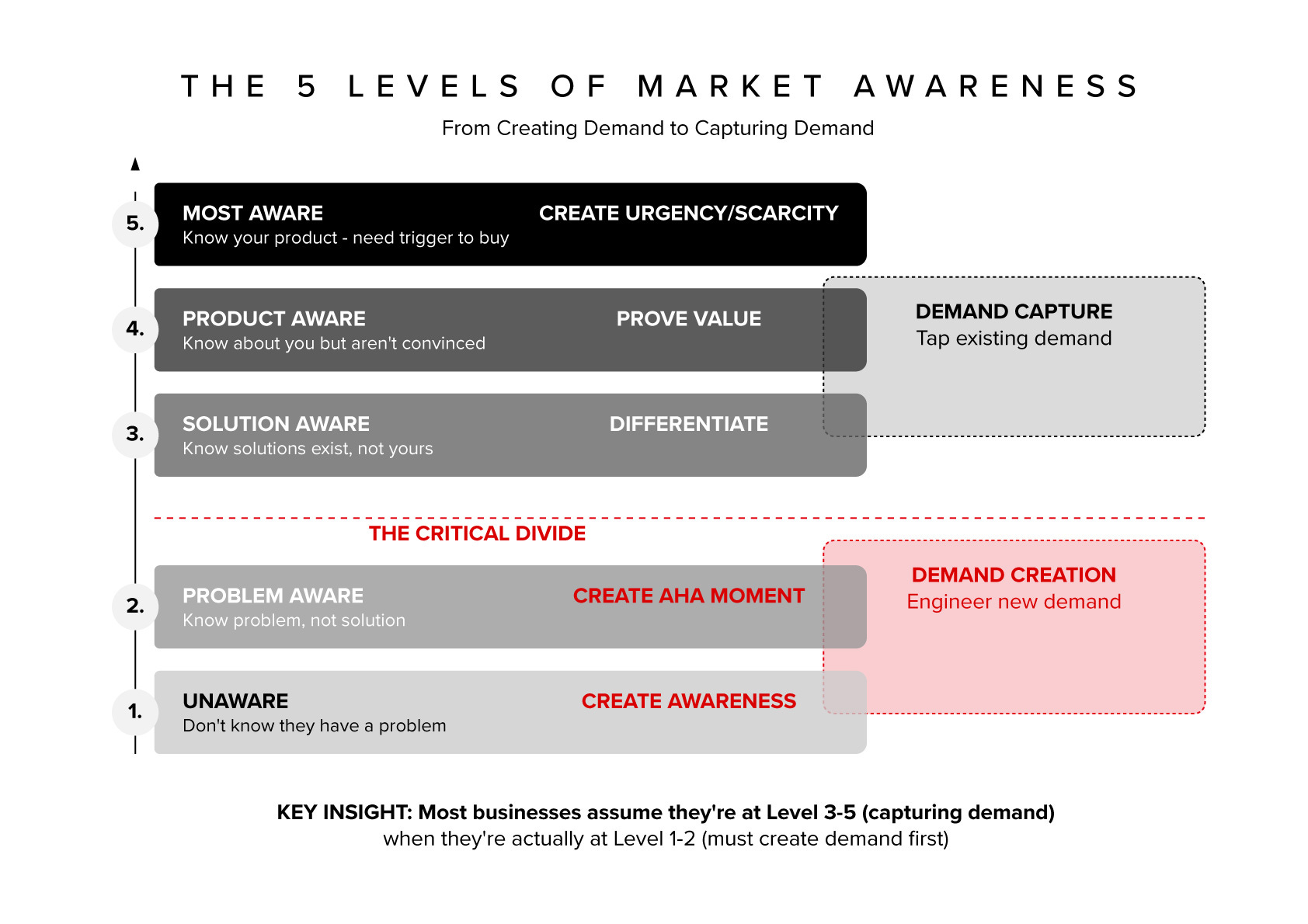
Most businesses get stuck because they’re trying to find demand that doesn’t exist yet. They need to engineer it first through AHA moment architecture, overwhelming value design, and channel-specific activation.
When we launched our communication methodology, we weren’t tapping existing demand for “strategic communication consulting.” We had to create awareness that communication chaos was costing businesses millions, then design the AHA moment that our methodology could solve this invisible problem.
Micro-summary:
→ You’re not finding demand. You’re engineering it through designed awareness and AHA moments.
What Makes a Path “Clear”
A Clear Path isn’t just about having good metrics or happy customers. It’s about having three specific types of validation that, when combined, create certainty about scalability:
Mathematical Validation → Prove the Numbers
System Understanding → Explain the Why
Execution Proof → Stress-Test Delivery
Mathematical Validation: The Numbers Actually Work
This isn’t about revenue growth or customer satisfaction scores. It’s about unit economics that make sense under stress. Can you acquire customers profitably? Do the margins work when you factor in all costs? Will the math hold up at 10x scale?
In Velocity, our mathematical validation came when we consistently hit €40 customer acquisition cost with 15% monthly churn. These weren’t arbitrary numbers. They were the specific thresholds that proved our economics could sustain aggressive growth. We didn’t just have customers; we had mathematically proven that we could acquire them profitably at scale.
System Understanding: You Know How It Actually Works
This is about deeply understanding the mechanics of your business. Why do customers buy? What drives retention? How does your delivery process actually function under load? Which awareness level is your market at, and how are you engineering demand?
Most businesses can explain what their customers do, but they struggle to explain why they do it. Clear Paths requires understanding the underlying system. The real reasons customers convert, stay, and recommend you.
For us, this meant understanding that our content worked because it solved a very specific problem at a very specific moment in our subscribers’ journey. We knew exactly which content types drove engagement, which delivery methods maximized retention, and how our onboarding sequence influenced long-term value.
But more importantly, we understood we were operating at awareness Level 2. We had to create the problem awareness first (”you’re not getting tactical business insights efficiently”), then engineer the AHA moment (”what if you could get Netflix-quality business content for €10/month?”).
System understanding includes:
Knowing your demand creation mechanism
Understanding value perception drivers
Being able to replicate success predictably
Controlling the key variables that drive results
Designing AHA moments that connect problems to solutions
Execution Proof: You Can Actually Deliver
Having great economics and understanding your system means nothing if you can’t execute reliably. Execution proof means demonstrating that you can deliver your product or service consistently, at the quality level customers expect, without breaking your operations.
This is where most scaling attempts break down. The business that works at 100 customers often doesn’t work at 1,000 customers. Systems that feel robust at small scale collapse under growth pressure.
Our execution proof came from successfully handling demand spikes, maintaining content quality under pressure, and proving our customer success processes could scale without proportional increases in manual effort.
Execution proof requires:
Multiple successful iterations of your process
Team ability to execute without constant oversight
Systems documented and proven to work
Scaling that doesn’t break quality
Channels validated with real data
When all three align —mathematical validation, system understanding, and execution proof— you don’t just have product-market fit. You have a Clear Path.
Micro-summary:
→ A Clear Path is when your numbers work, your system is understood, and your delivery is proven.
The Clear Paths Diagnostic
The beauty of Clear Paths Framework is that it eliminates the endless strategic discussions that keep you trapped in analysis mode. Instead of asking “Do we have product-market fit?” you ask three specific questions:
Do our unit economics work under stress? (Mathematical validation)
Do we understand why our system produces results AND which awareness level we’re operating at? (System understanding)
Can we deliver reliably at the next level of scale? (Execution proof)
If you can answer “yes” to all three with specific evidence, you have a Clear Path. If any answer is “no” or “maybe,” you know exactly where to focus your efforts.
This diagnostic transformed how we approached scaling decisions. Instead of gut feelings or hoping for the best, we had concrete criteria. When someone suggested a new growth initiative, we didn’t debate whether it was a good idea. We asked: “Do we have a Clear Path for this?”
For each potential path (paid ads, viral growth, partnerships, content marketing), you score:
Mathematical: Do the numbers work at scale?
System: Do we understand WHY it works and what awareness level we’re addressing?
Execution: Can we DO it repeatedly and reliably?
Only paths scoring 3/3 are truly “clear.”
The psychological shift was profound. We moved from “Should we scale?” to “How fast can we scale?” When you have Clear Paths, scaling becomes a question of execution speed, not strategic uncertainty.
Micro-summary:
→ Scaling isn’t a bet anymore. With Clear Paths, it’s engineered inevitability.
Clear Paths vs. Traditional Milestones
Traditional business metrics tell you what happened, but Clear Paths tell you what’s possible. Revenue growth is a lagging indicator. Customer acquisition numbers are interesting but don’t predict scalability. Even retention rates can be misleading if you don’t understand the underlying system.
I’ve seen businesses with impressive metrics that couldn’t scale because they lacked true Clear Paths. They had good numbers but couldn’t explain why those numbers existed or whether they’d persist under growth pressure.
Clear Paths flip this dynamic. Instead of tracking outcomes and hoping they continue, you validate the systems that create those outcomes. Instead of measuring what happened, you confirm what will happen when you scale.
The difference is between having confidence in your current performance and having confidence in your future performance. Clear Paths give you the latter.
The Velocity Case Study: Clear Paths in Action
When we decided to scale Velocity aggressively, we didn’t do it because we had “good metrics.” We did it because we had Clear Paths.
Mathematical Validation: €40 CPA with 15% monthly churn meant we could sustainably reach 5,000 subscribers at €50,000 monthly revenue. The math wasn’t hopeful. It was inevitable.
System Understanding: We knew exactly why our content worked. Our subscribers were entrepreneurs and business owners who needed tactical insights they could implement immediately. But more critically, we understood we were operating at awareness Level 2. We had to create the demand for “Netflix for business” because that category didn’t exist.
Our content format (short, actionable videos with accompanying resources) hit that engineered need precisely. We understood the psychology of our audience, the mechanics of our content delivery, and how our framing created the AHA moment that transformed interest into demand.
Execution Proof: We had successfully handled demand spikes during product launches, maintained content quality under pressure, and proven our customer success processes could scale without hiring proportionally more people.
With these three validations in place, scaling wasn’t a hope or a gamble. It was systematic execution of a proven model.
The results spoke for themselves: €100,000 to €1 million ARR in 9 months. But more importantly, the growth felt controlled and sustainable because we knew exactly what we were scaling and why it worked.
Without Clear Paths thinking, we would have approached scaling the way most businesses do. Gradually, cautiously, constantly second-guessing whether we were ready. With Clear Paths, we could scale aggressively because we had mathematical proof our system worked.
Implementation: Your Clear Paths Checklist
Ready to apply Clear Paths thinking to your business? Start with these diagnostic questions:
Awareness Level Assessment:
What awareness level is your market at (1-5)?
Are you tapping existing demand or creating new demand?
Do you have AHA moment architecture for Level 1-2 markets?
Mathematical Validation:
Can you acquire customers at a cost that allows profitable scaling?
Do your unit economics hold up under stress testing?
Are your margins sustainable at 10x current volume?
Is your LTV at least 3x your CAC?
System Understanding:
Can you explain exactly why customers choose you over alternatives?
Do you understand the specific triggers that drive customer action?
Can you predict customer behaviour based on system mechanics rather than hoping?
Do you know which awareness level you’re operating at and how you’re engineering demand?
Execution Proof:
Have you successfully delivered under pressure without breaking quality?
Can your current systems handle 3x growth without major overhauls?
Do you have evidence that your processes scale efficiently?
Can your team execute without constant oversight?
Red flags that indicate unclear paths:
You’re “pretty sure” the economics work but haven’t stress-tested them
You know your customers like your product but can’t explain exactly why
You’ve never operated under significant demand pressure
Your success feels somewhat mysterious or hard to replicate
You’re assuming demand exists without validating awareness levels
When you have Clear Paths, you’ll know. The uncertainty that keeps you stuck in strategic thinking mode disappears. You stop wondering if you should scale and start focusing on how to scale most effectively.
The Power of “No Clear Path”
Knowing you DON’T have a clear path is as valuable as having one. It saves wasted resources, forces innovation, clarifies what’s missing, and guides intelligent pivots.
Instead of: “We think we have product-market fit”
You know: “€30 CPA on Facebook with 25% month-1 retention” or “Zero demand on Meta despite testing” or “40% webinar conversion with €2K price point”
This precision transforms scaling from gambling to engineering.
From Strategic Paralysis to Strategic Execution
That’s the true power of Clear Paths. It doesn’t just give you permission to execute. It gives you confidence that execution will work. For entrepreneurs who get trapped in the idea stage, Clear Paths provides the antidote to strategic addiction.
Instead of chasing the next strategic insight, you have specific criteria that tell you when it’s time to stop strategizing and start scaling. You move from hoping the market wants what you built to actively engineering demand through designed mechanisms, validated channels, and overwhelming value architectures.
In a world where attention is scarce and competition infinite, the ability to create clear paths to engineered demand becomes the difference between businesses that scale and those that stay stuck in strategic thinking mode.
You’re not an archaeologist looking for pre-existing fit. You’re an architect designing paths to inevitable growth.
I don’t have all the answers, nobody does. These frameworks are simply how I make sense of the chaos. Take what serves you, leave what doesn’t, and keep building.
Building Strategic Architecture, Edward Azorbo