
#8 Strategic Sequence


Welcome to the Strategic Architecture Universe: where timing beats talent, the order of triggers creates compound momentum, and understanding sequence transforms struggle into inevitability.
Edward Azorbo
The Order of Inevitability: Why Your Strategy Isn't Working (Yet)
I remember early in my career as an entrepreneur when my go-to method of trying to grow a business was to do 4 or 5 projects at the same time. We know how that ends up. It actually takes much longer than finishing one project first. Classic beginner's mistake.
What no one talks about: basic project management should be mandatory for entrepreneurs.
I remember one of my boxing teachers, Ray, would say sequence matters and defense first.
You can't box if you can't protect yourself.
In one of my articles, I shared how Strategic Triggers create those binary transformation points that fundamentally change what's possible in your business. But here's the question that naturally follows: in what order should these triggers be pursued?
This is where Strategic Sequence becomes crucial. The forgotten element that makes the difference between struggle and inevitable success.
The Bootstrapper's Dilemma
Many consulting businesses and service agencies have been built with the dream of eventually funding software projects or scalable subscription models. My story is no different.
I always saw the higher transaction size services business as the means to an end, the funding vehicle for creating something less dependent on human factors and more infinitely scalable. It's the classic entrepreneur's journey: start with services, transition to products, build a subscription engine, and eventually "hopefully" create a true tech platform.
What nobody tells you is just how capital-intensive this evolution can be. Most subscription businesses operate at a loss for quite a while before reaching sustainability. If you're dependent on generating that capital yourself, as I was, the sequence becomes everything.
When we launched Velocity, our subscription business, we weren't backed by venture capital. Every euro needed to scale came from our consulting work. Without understanding the right sequence, we would have burned through resources too quickly, expanded prematurely, or worst of all, pulled money from places that would have crippled our core business.
The path from service business to scalable platform isn't just about working harder or moving faster. It's about understanding what must come first, what naturally follows, and what transformations must occur at each stage to enable the next.
This isn't just my story. It's the hidden pattern behind virtually every successful bootstrapped business evolution. Yet it's rarely discussed in strategic frameworks, where the focus tends to be on isolated goals rather than the crucial order of operations.
"The path from service business to scalable platform isn't just about working harder or moving faster. It's about understanding what must come first."
The truth is simple but profound: Even with the right triggers identified, pursuing them in the wrong sequence is like trying to build a house starting with the roof. It doesn't matter how well-designed your roof is if there's no foundation to support it.
In my previous article, I shared how Strategic Triggers act as those binary transformation points. The moment when everything changes in your business. Now it's time to understand how these triggers form a sequence, where each one creates the conditions necessary for the next, building compound momentum until success becomes practically inevitable.
This isn't just about planning stages, it's about understanding the natural evolution of business growth, where certain things must happen before others can follow. It's about creating what I call "strategic patience." Knowing exactly when to move forward and when to wait because the foundation isn't ready.
So let's explore the art and science of Strategic Sequence. The crucial element that turns isolated successes into an inevitable progression toward your biggest goals.
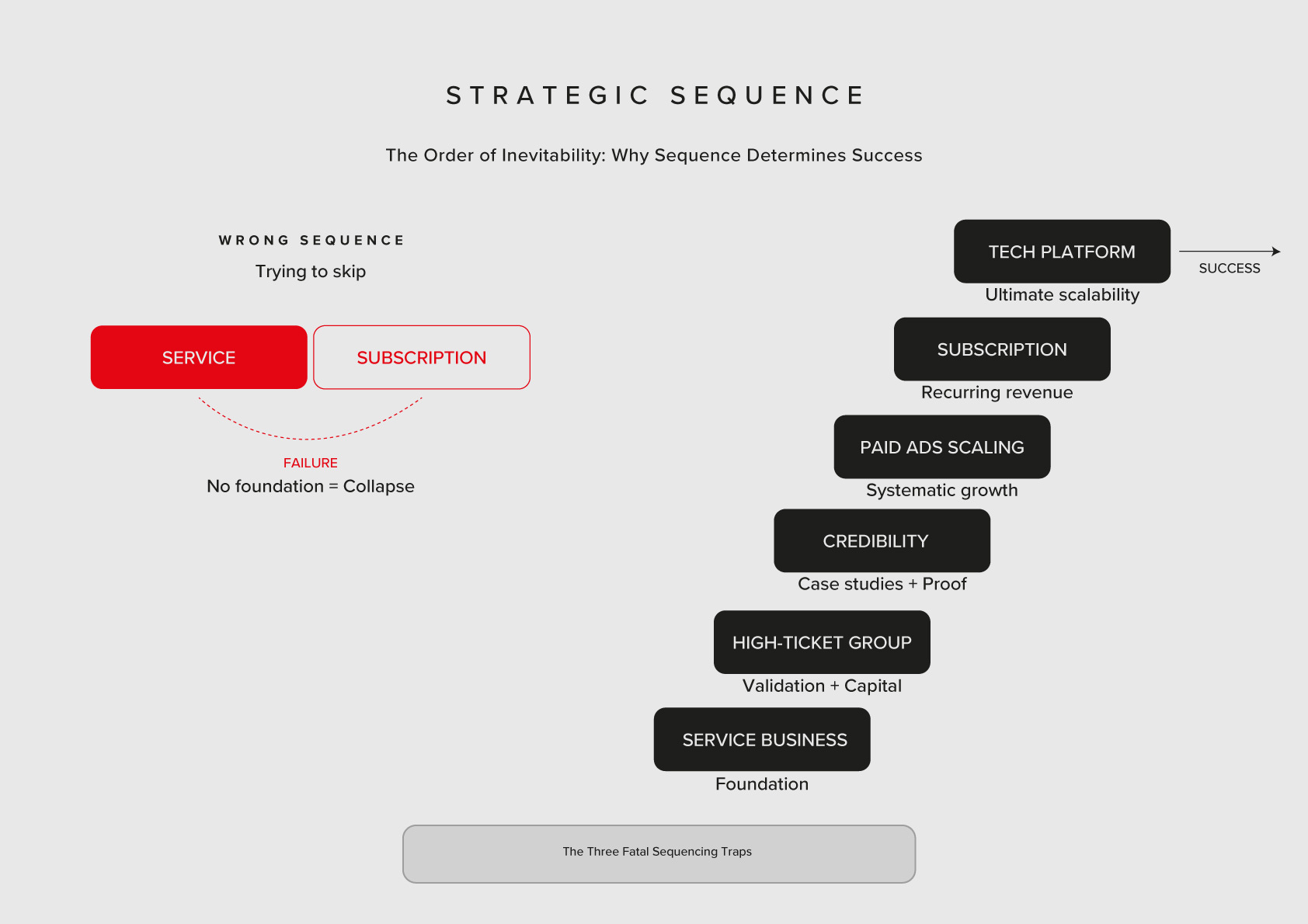
The Three Fatal Sequencing Traps
"Even with the right triggers identified, pursuing them in the wrong sequence is like trying to build a house starting with the roof."
Trap #1: Trying to do everything at once
This is the classic mistake many entrepreneurs make. I know I made this mistake. The invincibility complex in which we think we can scale two businesses at the same time, being naïve to the reality of business. Focus is a skill, and when we start, this skill is not yet developed.
In the beginnings of our consulting business, we decided to launch our backend product. A natural expansion that seemed to make sense. But the reality is we weren't ready. The main product needed more tweaks and improvements. Despite our enthusiasm, we launched the backend offering and ultimately ended up returning €30,000 in payments because we saw clearly that the quality would not be right.
The timing simply wasn't right. We needed to get the core product to a top level before going for the backend. We needed to have delivery, customer satisfaction, and other fundamentals as good as possible. Otherwise, we'd have quality issues that would affect the whole business.
This wasn't about the backend product being a bad idea. It was about sequencing. The core business wasn't yet stable enough to support expansion. By trying to do both simultaneously, we risked damaging our reputation and wasting resources that could have been used to perfect our primary offering.
When we later revisited the backend product idea after ensuring our core business was running smoothly, it was successful because it was built on a solid foundation. This experience taught me that sometimes the right move at the wrong time is still the wrong move.
Micro-summary:
→ This is one of the biggest failures I see with clients. Wrong sequencing and they never take off. Nearly always they do what they would like to do, NOT what should be done in the sequence.
Trap #2: Focusing on the wrong actions at the wrong time
Sometimes we're drawn to the sexy actions, often linked to emerging trends. A new channel pops up, and we drop everything to try it out. (Anyone remember Clubhouse?)
At one point in Velocity, we were scaling nicely with paid ads. The system was working. Customer acquisition costs were stable, conversion rates were good, and growth was predictable. Somehow, I decided a good idea would be to launch an affiliate program. It seemed simple enough to run and capture affiliates, potentially opening a new growth channel.
But it mentally took me away from things that were already working. I now had to manage an affiliate manager, figure out how to make the program attractive, design tracking systems, and handle partner relationships. Even though it was only about 3 hours of my time per week, the mental distraction was far costlier than those hours suggest.
The problem wasn't that affiliate marketing is inherently bad. It was that this wasn't the right time in our sequence. We had a working growth engine that needed optimization and refinement, not a completely new channel that would divide our attention. We shut the program down after 4 months, returning our focus to what was already working.
This taught me an important lesson about sequence: sometimes the most valuable thing you can do is to keep optimizing what's already working rather than adding something new. The right action at the wrong time becomes the wrong action.
Micro-summary:
→ Launch a subscription business without generating the capital first. Sell a high-ticket product without creating case studies and social proof. Try to scale without validated key metrics or Clear Paths. These are sequence failures.
Trap #3: Missing the critical transformation moments
Here triggers are key. Sometimes an easier goal that enables transformation is more strategic and logical compared to a grand goal. Simple is usually better, and many times there are simple triggers we can aim for that will create disproportionate impact.
For example, reaching five sales calls per day might seem like a modest goal compared to "double revenue," but if those five calls would allow you to validate a sales script that could later be delegated, it becomes a critical transformation moment. A trigger that opens the door to systematic scaling.
These transformative moments are where mathematical freedom happens. It's not the size of the number, but the strategic freedom it creates that matters.
Real-world example: The Knowledge Business Sequence
One example I see often is in the knowledge business space. Many experts get stuck with books or 1-to-1 sessions, believing that's the natural starting point. Nothing wrong with those, but the reality is that most of the successful knowledge businesses we've worked with followed this sequence:
Launch a beta flagship product with group consulting or coaching at a high-ticket price point
Collect credibility elements. Testimonials, case studies, documented results
Relaunch with paid ads and scale to a 7-figure business
Compare this to trying to publish a book and hoping to make it a bestseller in a year. That's the James Clear model. Viable but incredibly difficult and time-consuming.
The first approach creates immediate validation, generates revenue while building credibility, and establishes a clear path to scale. The second approach requires years of work before seeing significant returns, and even then, the path to monetization remains unclear.
The difference isn't in the goals. Both approaches aim to establish expertise and build a business. But in the sequence. One creates immediate momentum that compounds naturally; the other requires a much longer timeline with less certain outcomes.
Understanding the right sequence isn't about lowering your ambitions. It's about achieving them in the most efficient, predictable way possible.
Micro-summary:
→ Strategic patience isn't waiting. It's knowing exactly what must happen first to make what comes next inevitable.
The Power of Strategic Patience
Patience has never been my strong suit. I expect many entrepreneurs share this flaw. We're wired for action, not waiting. But understanding sequence fundamentally changed how I view patience.
The right sequence creates what I call "strategic patience." When you truly understand the natural order of things. When you know that A must happen before B becomes possible. Waiting for results to unfold becomes an integral part of the process, not a frustrating delay.
This isn't about moving slowly. It's about moving in the right order, which paradoxically often leads to faster overall progress. Like a chess master who understands that controlling the center must come before an aggressive attack, you gain the clarity to make moves in their optimal sequence.
"Strategic patience isn't waiting. It's knowing exactly what must happen first to make what comes next inevitable."
Connecting Sequence to Triggers
This is where Strategic Sequence and Strategic Triggers combine to create the backbone of the Strategic Inevitability methodology. Triggers tell you what transformation points matter most, while Sequence tells you the order in which to pursue them.
When you identify the right triggers and arrange them in their natural sequence, you create a pathway where:
Each achievement makes the next one easier
Resources compound rather than deplete
Momentum builds naturally with each step
Success becomes not just possible, but increasingly probable
In my next article, I'll explore how to identify the specific tactical actions. What I call Tactical Accelerators. That can help you hit these triggers with maximum efficiency and speed.
Until then, take a moment to consider: What's the natural next step in your business sequence? What needs to be validated, built, or transformed before you can move to the next level? The clarity of your answer might reveal just how close you are to inevitable success.
I don't have all the answers nobody does. These frameworks are simply how I make sense of the chaos. Take what serves you, leave what doesn’t, and keep building.
Building Strategic Architecture™, Edward Azorbo