
#7 The Trinity Framework: How to Engineer Inevitable Growth with Three Constraints


Welcome to the Strategic Architecture Universe: where infinite possibilities collapse into closed probability space, constraints create certainty from chaos, and systematic execution replaces endless analysis.
Edward Azorbo
The Cultural Lesson on Time
This isn't a story about culture. It's a story about impatience, systems, and the price of chasing speed.
The Trinity Framework uses three constraints that turn impatience into inevitable compounding, transforming anxiety into mathematical certainty.
Coming from a multicultural background, I've always been struck by how differently cultures relate to time.
My mother is Swedish, my father Nigerian, and I've lived most of my life in Spain. That mix taught me something unexpected: patience isn't universal, it's contextual.
In Sweden, time is optimized. Buses arrive on the dot. Food is served without delay. Efficiency is engineered into daily life.
Spain? A little looser. Things get done, but they take longer. There's more waiting, more flexibility built into the system.
Then there's Nigeria, where waiting isn't a delay, it's part of the design. I remember visiting my father's friends as a child. If they weren't home, you waited. An hour. Maybe more. Nobody rushed. Nobody complained. It was normal.
That contrast made something click years later: Impatience isn't just cultural, it's strategic.
And in business, the cost of impatience is steep.
I've paid that price in multiple currencies:
Tanked SEO rankings by chasing short-term gains
Hired the wrong people by rushing the process
Killed projects just before they would've worked because I expected speed, not emergence
“Impatience doesn't just delay results, it destroys potential.”
Emergence Requires Structure: The Need for a New Framework
The typical advice for someone like me is incomplete. Not actionable.
"Just be patient." "Trust the process." "Good things take time."
But that advice fails because it lacks constraints and rhythm. It's like telling someone to "just swim" when they're drowning. The advice isn't wrong, it's incomplete.
My anxiety and impatience weren't character flaws. They were signals that I needed structure, not empty advice.
I needed to know:
WHAT to be patient about (not everything)
HOW LONG to be patient (not forever)
WHAT ACTIONS to take while waiting (not passive hope)
The breakthrough came when I realized: I didn't need more speed, I needed structured patience. That's what the Trinity Framework gave me.
The Birth of a Framework
I have a pattern. When I feel real pain or face a persistent problem, I tend to create a framework. It's how my mind processes solutions.
The Trinity Framework was born from my need to solve the patience problem. Not the cultural patience I'd observed, but strategic patience. The kind that knows exactly what to wait for, how long to wait, and what to do while waiting.
The Trinity Framework™ Introduction
I used to love going to the race tracks in Sweden. Solvalla is Sweden's most famous track, and I spent countless hours there in my youth watching the trotters race.
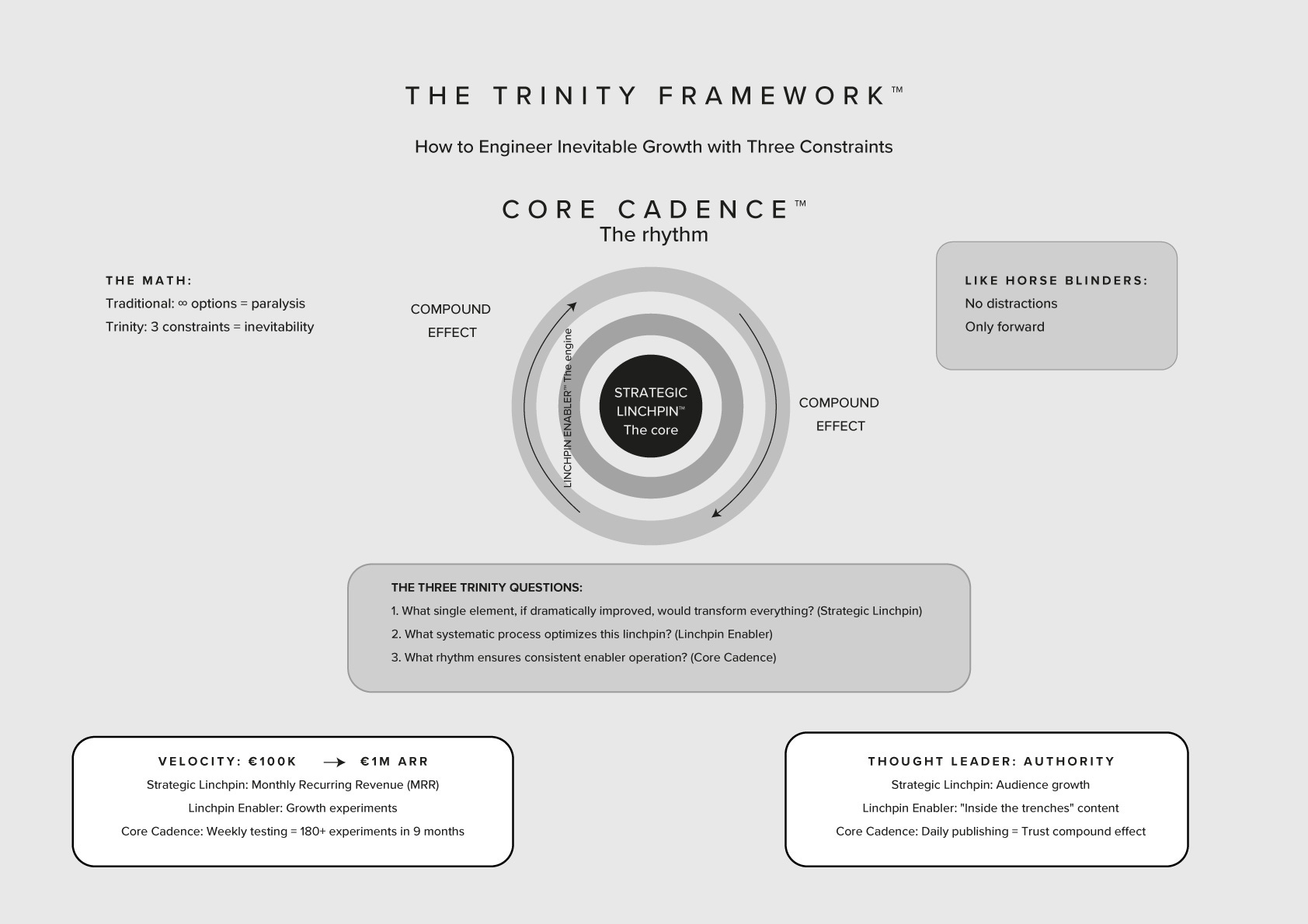
The horses wore blinders so they couldn't look to the side when racing. Only forward. Only their lane. No distractions.
Years later, building businesses in chaos, I realized I needed the same thing. Not physical blinders, but strategic ones. A system that would keep me focused on what matters, immune to the thousand distractions that kill momentum.
The Trinity Framework does exactly that. It's a strategic constraint system that protects against emotional volatility.
The framework has three layers that work together:
Layer 1: Strategic Linchpin
The single foundational element that powers everything else. This is your point of maximum leverage, the one thing that, when optimized, makes everything else easier or unnecessary. (Read the foundational article on Strategic Linchpin [here])
Linchpin test: "I ask myself: if this activity doesn't directly impact my linchpin metric, why am I doing it?"
Layer 2: Linchpin Enabler
The systematic mechanism that directly powers and feeds the linchpin. This is your optimization engine, the repeatable process that makes your linchpin stronger over time.
Enabler test: "Can you execute this exact same process next week without thinking? If not, it's not systematic enough."
Layer 3: Core Cadence
The systematic rhythm that drives the enabler consistently. This is your inevitability engine, the predictable execution pattern that ensures progress regardless of external chaos.
Cadence test: "If you keep breaking your rhythm, you don't have a cadence, you have hope."
Why It Works: The Mathematical Breakthrough
Traditional strategy drowns in infinite possibilities. Every option seems viable. Every path could work. Analysis paralysis sets in.
The Trinity Framework creates what I call a "closed probability space."
Instead of infinite options, you have three constraints:
ONE linchpin to optimize
ONE systematic way to feed it
ONE consistent rhythm to execute
This transforms strategy from hope into math.
The Compound Effect: Each successful cadence cycle increases the probability of the next success. Each enabler optimization makes the linchpin stronger. Each linchpin improvement creates more strategic freedom.
It's not magic. The goal is mathematical inevitability through systematic constraint.
Traditional strategy drowns in infinite possibilities. Every option seems viable. Every path could work. The Trinity Framework creates what I call a "closed probability space."
Two Real Examples
Velocity: From €100K to €1M ARR
When we applied the Trinity Framework to Velocity, everything changed.
Strategic Linchpin: Monthly Recurring Revenue (MRR)
Everything else became secondary
All decisions filtered through MRR impact
Created clarity in a chaotic market
Linchpin Enabler: Growth experiments
Systematic testing of acquisition channels
Data-driven optimization
No emotion, just results
Core Cadence: Weekly experiment testing
Every week, new test launched
No exceptions, no excuses
Rhythm created momentum
Result: 180+ experiments in 9 months. From €100K to €1M ARR.
The magic wasn't in any single experiment. It was in the compound effect. Each experiment taught us something, making the next one more likely to succeed. The cadence made learning systematic, not sporadic.
Thought Leadership Example: The Business Growth Expert
Consider a business growth expert building authority.
Strategic Linchpin: Audience growth
Not revenue (that comes later)
Not engagement (vanity metric)
Pure audience expansion
Linchpin Enabler: "Inside the trenches" content
Sharing what's actually working in real-time
No theory, all practice
Vulnerability creates trust
Core Cadence: Daily writing and publishing
Every day, without fail
Quality through quantity
Consistency creates expectation
Direct Result: Consistent audience growth
Cascade Effects:
Revenue growth (audience → customers)
Trust asset building (consistency → credibility)
Email list expansion (readers → subscribers)
Speaking opportunities (authority → invitations)
Premium client attraction (trust → willingness to pay)
The compound effect: Daily publishing created a trust engine where each piece built on the last. Miss a day? You break the compound effect. Stay consistent? Mathematical inevitability.
The Anxiety Solution
The Trinity Framework eliminated my entrepreneurial anxiety by answering three questions:
"Am I working on the right thing?"
Yes, if it feeds your linchpin
"Am I making progress?"
Yes, if you're maintaining cadence
"When will this work?"
When compound effects reach critical mass (calculable based on your cadence)
The framework doesn't eliminate uncertainty. It transforms it into a math problem.
Instead of "Will this work?" you ask "How many cadence cycles until this works?"
Instead of hoping, you're calculating.
Implementation: Your Trinity Design
To find your Trinity, ask three questions:
1. "What single element, if dramatically improved, would transform everything?"
This is your Strategic Linchpin. Common examples:
MRR for SaaS
Audience for thought leaders
Product excellence for premium brands
Network effects for platforms
2. "What systematic process optimizes this linchpin?"
This is your Linchpin Enabler. It must:
Directly feed the linchpin
Be repeatable and systematic
Create compound improvement
Work regardless of market conditions
3. "What rhythm ensures consistent enabler operation?"
This is your Core Cadence. Choose carefully:
Daily = 365 compound cycles/year
Weekly = 52 compound cycles/year
Monthly = 12 compound cycles/year
The math matters. More cycles = faster compound effects.
Common Mistakes to Avoid
Multiple Linchpins: "We optimize MRR AND user experience AND..." No. One linchpin. Everything else is secondary.
Broken Cadence: "We usually do weekly, but..." No exceptions. Broken cadence breaks compound effects.
Emotion Over System: "This week didn't feel productive..." Feelings don't matter. Cadence matters.
Impatience: "It's been 3 months and..." Compound effects have a curve. Trust the math.
The Linchpin Evolution
Your linchpin isn't permanent. It needs review multiple times per year because business evolves.
When you change your linchpin, everything changes:
Your enabler must be redesigned
Your cadence might need adjustment
Your measurement systems shift
This isn't failure. It's evolution. The Trinity Framework™ is a living system, not a static formula.
Common evolution triggers:
Hitting a major strategic trigger (like €1M ARR)
Market conditions shifting dramatically
Discovering a higher-leverage linchpin
Current linchpin becoming saturated
Review quarterly. Adjust when necessary. But never run multiple linchpins simultaneously.
Starting Tomorrow
The Trinity Framework isn't complex. It's three decisions:
Pick your linchpin
Design your enabler
Commit to your cadence
Then execute. Without exception. Without emotion. With mathematical certainty.
The framework taught me something my multicultural background had already shown me: Different approaches to time create different realities.
The Trinity Framework creates structured patience, where constraints don't limit you, they liberate you. Where impatience stops being a liability and becomes mathematically irrelevant. Where success becomes not a hope, but a calculation.
I don't have all the answers nobody does. These frameworks are simply how I make sense of the chaos. Take what serves you, leave what doesn’t, and keep building.
Building Strategic Architecture™, Edward Azorbo