
#5 The Strategic Linchpin


Welcome to the Strategic Architecture Universe: where ONE optimized element beats ten scattered initiatives, focus creates exponential leverage, and finding your linchpin transforms everything else automatically.
Edward Azorbo
The Strategic Linchpin: Why One Optimized Element Outperforms 10 Initiatives
I think Gary Keller's book The ONE Thing is one of the best business books on strategy—not a traditional academic book on strategy, but in many cases, more useful and actionable.
I have always admired authors who take one big idea and pound away at it relentlessly so that the reader finally gets it.
Lack of commitment to a few important things is costly. If I look back in time and see relationships that did not quite work, businesses that could have done better but didn’t because I was overcommitted to too many things it comes down to commitment to the few instead of the many. Essentially: lack of focus.
When I talk to younger entrepreneurs and they tell me about the three ventures they are launching, it takes me back in time because I was exactly that way.
Over time, as with any skill, if you keep at it long enough, you get better. And over time, I have gotten better at what we can call a fundamental entrepreneurship skill: the skill of focus.
Normally, when I come up with a framework, it’s because I have a challenge or problem that I need to solve. Frameworks are my release valves of tension.
As we enter the deep end of this new AI era, we need to be clear about what's coming. We will not have fewer choices, fewer options, fewer shiny objects. Most likely, we'll have exponentially more. AI will generate endless possibilities, endless strategies, endless tactics to try. Having a clear criterion for focus has always been essential but now it's absolutely critical for survival.
The Strategic Linchpin framework was born from my obsession with figuring out how to focus on less and find the highest-leverage element in a strategy. I’d like to thank Gary Keller since I might not have been able to reach this insight without having read his book in my early years. This framework was directly inspired by Russell Brunson's concept of the "linchpin" in his book. Brunson identified the linchpin as a critical growth mechanism, and I'm building on that insight to show how it functions as the fundamental driver of entire business systems—creating focus and enabling clear resource allocation decisions.
I have built on this idea of one main focus and attempted to create a complete framework called the Trinity Framework™.
It is comprised of three elements: the Strategic Linchpin (your focus), the Linchpin Enabler(what powers it that you can directly impact), and the Core Cadence (your execution rhythm).
For example:
Strategic Linchpin – monthly recurring revenue
Linchpin Enabler – paid ads and growth experiments
Core Cadence – creative testing and experiments executed daily
For now, let's dig into the linchpin itself how to identify it, understand it, and use it to transform your business. Understanding that it's part of a larger integrated system gives you the complete picture of how focus translates into systematic execution.
The Everything-Is-Important Trap
Most businesses suffer from what I call "strategic diabetes"—everything looks sweet, so they try to optimize everything simultaneously.
Porter's Five Forces analysis tells you to worry about suppliers, buyers, competitors, substitutes, and new entrants. SWOT frameworks have you tracking strengths, weaknesses, opportunities, and threats. Balanced scorecards demand attention to financial, customer, internal process, and learning perspectives.
When everything is labeled "strategic priority," nothing actually is.
I've watched brilliant entrepreneurs burn out trying to move fifteen different levers at once. They'll spend Monday optimizing their sales funnel, Tuesday improving customer service, Wednesday refining their product, Thursday working on team culture, and Friday analyzing competitor moves. Each activity feels important—and individually, they might be. But the cumulative effect is exhaustion without transformation.
The problem isn't that these activities lack value. The problem is treating them as if they all carry equal strategic weight—when in reality, most strategic elements are interconnected dependencies of a few foundational drivers.
The Strategic Linchpin Defined
Before we dive into business applications, let's understand what a real linchpin actually is.
A linchpin is a small metal pin that goes through the end of an axle to keep a wheel from falling off. It's often the smallest, cheapest component on the entire vehicle—maybe worth €1 on a €50,000 truck.
But here's what makes it fascinating: remove that tiny €1 piece, and the entire €50,000 vehicle becomes worthless. The wheel falls off. The truck can't move. Everything stops.
The linchpin isn't the most expensive part. It's not the most complex part. It's not even the most visible part. But it's the part that holds the entire system together. Without it, nothing else functions.
This is the perfect metaphor for business strategy.
The Strategic Linchpin is the single foundational element within your business that powers the entire system and enables all other strategic moves. When optimized, it creates mathematical freedom for strategic choices and acts as the multiplier for all other efforts.
This isn't just your most important metric or your biggest revenue driver. It's the element that, when strengthened, makes everything else easier, more effective, and more profitable.
The Multiplication vs. Addition Principle
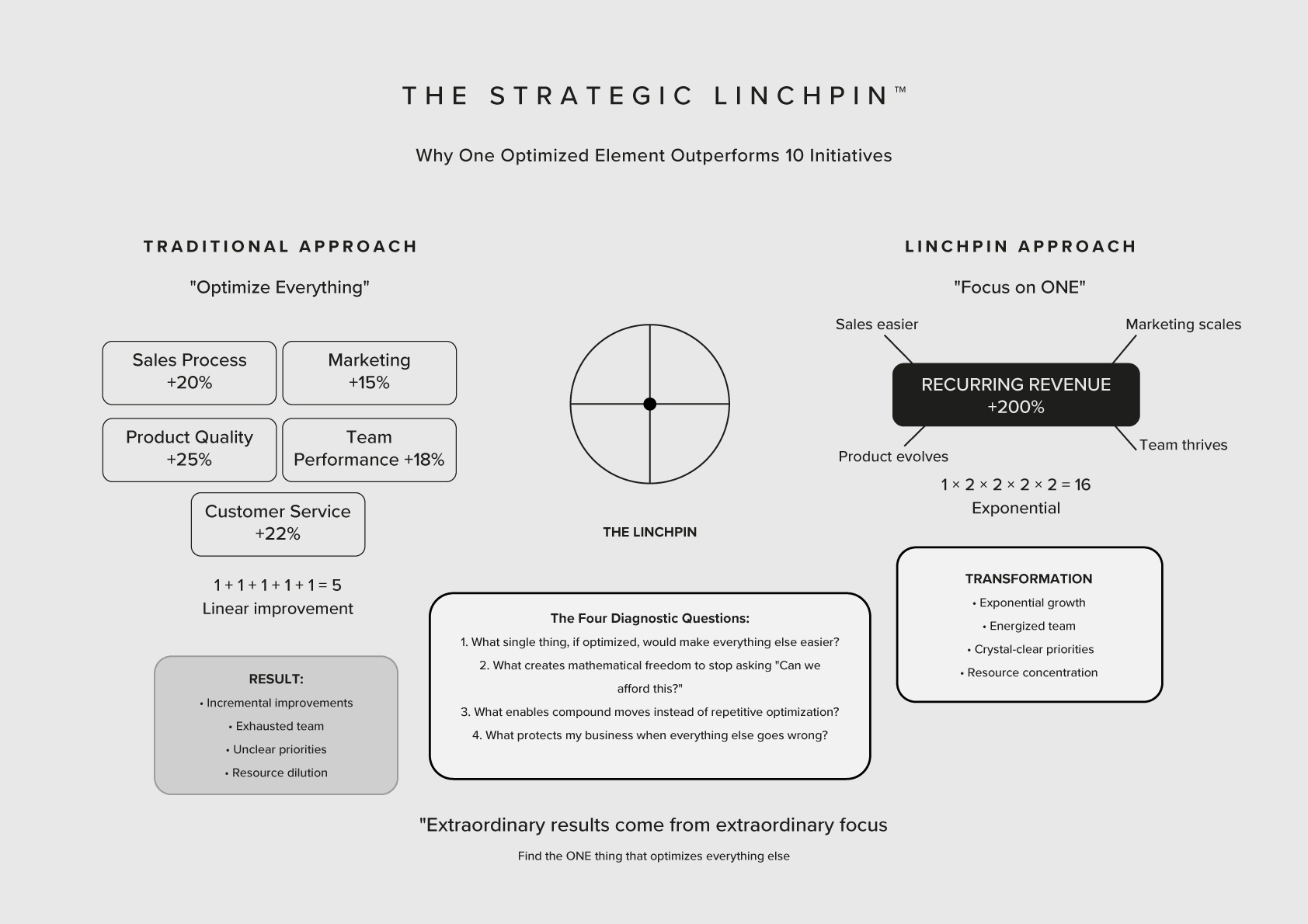
Traditional strategic thinking operates on addition logic: improve five things by 20% each, and you get 100% better results. But Strategic Architecture operates on multiplication logic: optimize the ONE foundational element, and everything else improves exponentially.
Here's the mathematical difference:
Addition Thinking: 1 + 1 + 1 + 1 + 1 = 5 (Linear improvement)
Multiplication Thinking: 1 × 2 × 2 × 2 × 2 = 16 (Exponential through linchpin optimization)
When you identify and optimize your Strategic Linchpin, you don't just improve one element—you create a cascade effect that amplifies every other part of your business.
The Four Diagnostic Questions
Finding your Strategic Linchpin requires asking the right questions. Here are the four that cut through the noise:
1. "What single thing, if I optimized it, would make everything else easier?"
This is the classic leverage question, but most people overthink it.
When our recurring revenue hit €30K monthly, suddenly everything became easier. Marketing decisions went from "Can we afford this campaign?" to "How fast should we scale it?" Sales conversations improved because we had mathematical confidence. Team building shifted from filling gaps to strategic hiring.
Simple example: A consulting firm realizes their proposal win rate is their linchpin. Optimize that from 30% to 60%, and suddenly they need half the leads, their cash flow stabilizes, and they can be more selective with clients.
2. "What creates the mathematical freedom to stop asking 'Can we afford this?'"
This question reveals the threshold that transforms scarcity thinking into abundance thinking.
For us, that €30K MRR threshold meant we could reinvest the entire amount back into growth without touching our base business. We crossed from survival mode to growth mode at a specific, mathematical point.
Simple example: An e-commerce business discovers that €50K in working capital is their freedom number. Below that, every decision is constrained. Above it, they can buy inventory in bulk, negotiate better terms, and take advantage of opportunities.
3. "What enables compound moves instead of forcing me to optimize the same things over and over?"
Your linchpin should create the foundation for strategic investments, not just better performance.
When our video production became our linchpin, it didn't just improve our ads. It compounded into brand positioning, audience building, and market leadership. Each video made the next one more powerful.
Simple example: A software company identifies their development team capability as their linchpin. Instead of outsourcing features, they invest in building internal expertise. Each project makes them stronger, creating compound capability gains.
4. "What protects my business when everything else goes wrong?"
Your linchpin should create stability during chaos while enabling aggressive growth during good times.
Our recurring revenue base meant that even if our acquisition stopped tomorrow, we had breathing room to figure things out. It became our strategic anchor.
Simple example: When that same recurring revenue becomes strong enough, it protects the entire business. New client acquisition becomes opportunity rather than necessity.
The Recurring Revenue Revelation
Let me share how this played out in our own business through a concrete example that demonstrates the cascade effects of linchpin optimization.
For years, we optimized different elements: better sales processes, improved service delivery, enhanced marketing campaigns, stronger team training. Each improvement helped, but nothing created the transformation we were seeking.
The breakthrough came when we identified our Strategic Linchpin: monthly recurring revenue and we launched our subscription business Velocity.
When we reached €30,000 in monthly recurring revenue, everything changed. This wasn't just about having more money—it was about having mathematical freedom to make strategic choices from strength rather than survival.
The Cascade Effects
Before Linchpin Optimization:
Marketing decisions constrained by cash flow limitations
Product development focused on survival features
Team building treated as necessary expenses
Competitive positioning was reactive
After Reaching €30K MRR Linchpin:
Marketing transformation: From "What can we afford?" to "How fast can we scale?" We could reinvest the entire €30K back into growth, creating exponential expansion
Product evolution: Resources became available for strategic capabilities rather than just survival features
Market positioning: We moved from reactive responses to proactive market creation
Strategic freedom: The mathematical certainty enabled bold moves that were previously impossible
One optimized metric—recurring revenue—triggered a full-system transformation. That’s the power of a true linchpin.
This single optimization—reaching our recurring revenue linchpin—created what I call "manufactured inevitability." Success became systematic rather than hopeful.
Common Linchpin Patterns
Through analyzing hundreds of businesses, I've noticed clear patterns in what typically becomes the linchpin.
For SaaS businesses, it's almost always monthly recurring revenue—once you hit that magical threshold where your base covers all costs, everything transforms.
Service businesses usually discover their linchpin is systematized trust and reputation, which enables premium pricing and makes sales conversations easier.
E-commerce companies often find that maximizing customer lifetime value becomes their foundation for aggressive acquisition.
Manufacturing businesses typically see production capacity utilization as their linchpin—optimize that, and cost advantages plus strategic flexibility follow naturally.
The Linchpin vs. Everything Else Approach
Traditional Approach (Optimizing Everything):
Sales process improvement: +20%
Marketing effectiveness: +15%
Product quality enhancement: +25%
Team performance: +18%
Customer service: +22%
Net result: Incremental improvements, exhausted team, unclear priorities, resource dilution
Strategic Linchpin Approach (Focus on ONE):
Recurring revenue optimization: +200%
Cascade effects: Sales becomes easier (mathematical confidence), marketing works better (reinvestment capacity), product improves (development resources), team performs better (stability and growth), customer service enhances (resource availability)
Net result: Exponential improvement, energized team, crystal-clear priorities, resource concentration
Trying to optimize everything leads to exhaustion. Optimizing your linchpin leads to exponential clarity.
The Implementation Process
Step 1: Identification Using the Four Questions
Apply each diagnostic question systematically. The element that appears in multiple answers is typically your Strategic Linchpin.
Step 2: Mathematical Validation
Test whether optimizing this element actually creates the freedom and leverage you expect. Small improvements to your potential linchpin should create noticeable improvements elsewhere in your system.
Step 3: Systematic Optimization
Once validated, redirect the majority of your strategic efforts toward optimizing this single element. This isn't about abandoning everything else—it's about recognizing that optimizing your linchpin makes everything else work exponentially better.
Step 4: Protection and Evolution
Build systems to protect your linchpin from volatility and ensure it continues evolving as your business scales. Your linchpin may evolve as your business architecture matures.
Strategic Architecture Integration
The Strategic Linchpin integrates seamlessly with other Strategic Architecture frameworks:
Strategic Triggers often center around linchpin optimization milestones and transformation points
Power Numbers frequently relate to linchpin performance thresholds that create mathematical freedom
Clear Paths use linchpin health as a primary validation criterion for scaling readiness
Threshold Accelerators work most effectively when specifically designed to strengthen your linchpin
Strategic Surplus is often generated through linchpin optimization, creating the "strategic oxygen" needed for growth
When your entire Strategic Architecture is built around your linchpin, you have what I would call strategic power—the whole structure feels more solid.
Why Most Businesses Miss Their Linchpin
The Strategic Linchpin concept seems almost too simple, which is exactly why most businesses miss it. We're conditioned to believe that complex problems require complex solutions. The idea that ONE optimized element could transform everything feels reductive.
Finding your Strategic Linchpin requires deep understanding of how your business system actually works, not just how you think it should work.
Sales thinks revenue generation is everything. Marketing believes customer acquisition drives success. Operations insists that delivery excellence matters most. Without a systematic approach to identifying the true linchpin, you end up trying to satisfy everyone's perspective simultaneously.
The Competitive Advantage of Linchpin Thinking
When you operate from a clearly identified and optimized Strategic Linchpin, you gain advantages that competitors operating in "everything is important" mode simply cannot match:
Resource Concentration: Your efforts are focused rather than scattered, creating exponentially better results from the same inputs.
Decision Clarity: Strategic choices become obvious because you have a clear criterion for evaluation: "Does this strengthen our linchpin?"
Strategic Patience: You can resist shiny object syndrome because you understand exactly what drives your business forward.
Systematic Growth: Improvements compound because they're all connected to the same foundational element.
The Evolution Factor
Your Strategic Linchpin isn't permanent. As your business evolves through different stages, what serves as your linchpin may need to evolve too. The key is recognizing when this shift needs to happen and making the transition deliberately.
For early-stage businesses, the linchpin might be product-market fit validation. For scaling businesses, it might shift to operational efficiency or recurring revenue. For mature businesses, it might become innovation capability or market position defense.
Beyond the Linchpin: Strategic Architecture Mastery
The Strategic Linchpin framework represents a fundamental shift from complexity to clarity in strategic thinking. It transforms the abstract concept of "focus" into a concrete methodology for strategic dominance.
When you optimize your linchpin, you don't eliminate other activities. You eliminate the anxiety, uncertainty, and inefficiency that comes from not knowing which activities actually matter most. You create the mathematical freedom to pursue opportunities from strength rather than desperation.
The linchpin isn’t just a focus it’s the foundation of your entire Strategic Architecture.
In our increasingly complex business environment, the Strategic Linchpin becomes your anchor—the ONE thing you can focus on that makes everything else not just possible, but inevitable.
As Gary Keller proved with his ONE Thing philosophy, extraordinary results come from extraordinary focus. The Strategic Linchpin takes this insight and makes it systematically applicable to Strategic Architecture, providing the foundation upon which all other strategic frameworks can build.
It's interesting—many times when I start working with clients, I have to pre-sell them on the idea that they will get less to do, not more. I tell them that's where I add value. Funny enough, there's always someone who says they want more. This is human nature—we think more is always better. Sometimes we need to experience mistakes firsthand. Focus, I believe, comes when you have paid the price multiple times, you've tripped over the same log several times, and you finally said "okay, I think I get it." At least that's what it was like for me.
The question isn't whether you should find your Strategic Linchpin.
The question is: how long will you continue optimizing everything before you discover the ONE thing that optimizes everything else?
I don't have all the answers nobody does. These frameworks are simply how I make sense of the chaos. Take what serves you, leave what doesn’t, and keep building.
Building Strategic Architecture™, Edward Azorbo