
#4 The Emergence Acceleration Thesis: Why Traditional Strategy Dies in the AI Era

Welcome to the Strategic Architecture Universe™: where emergence accelerates beyond traditional strategy's ability to respond, chaos becomes competitive advantage, and antifragile systems turn disruption into fuel.
Edward Azorbo
The Emergence Acceleration Thesis: Why Traditional Strategy Dies in the AI Era
Strategy dies when change cycles outrun analysis. Most businesses aren't ready for the emergence tsunami that's about to hit. Here's the replacement.
Emergence: Valuable opportunities arising from systems that weren't planned or predicted, accelerating exponentially in the AI era, making traditional strategy mathematically impossible.
In November 2022, ChatGPT launched. By mid-2023, within months, it began eroding key information advantages that strategy consultants had held for decades. What took decades to disrupt in previous eras now happens in quarters.
As an entrepreneur who's always wanted more control over events, this initially challenged my thinking. But then I realized something crucial: faster change doesn't just create more chaos, it creates exponentially more emergent opportunities.
The problem? Most businesses are still using strategic frameworks designed for a world where major disruptions happened every 10–20 years. Now they happen every 6–12 months. Traditional strategy isn't just outdated — it's become mathematically impossible.
Here's what I'm learning about emergence through building businesses in this accelerated world.
Understanding Emergence
When I first discovered the concept of emergence, I found it fascinating. Like many entrepreneurs, I've always wanted more control over events and outcomes. Understanding emergence opened my mind to the idea that business and life don't necessarily flow in the linear fashion we humans would prefer.
When I first started Brazilian Jiu-Jitsu, I thought I was doing it for control — learning to defend myself, manage situations, gain an edge. But what I saw over and over again, in myself and others, broke that narrative completely.
Someone decides to start the sport purely for self-defense reasons. What emerges is something entirely unexpected: they become part of a community, lose weight, make lifelong friends, develop better self-esteem, and transform their entire lifestyle. They rarely joined for any of these reasons, yet these emergent outcomes often become more valuable than the original goal.
This is emergence in action: valuable outcomes that arise naturally from a system, but weren't planned or predicted at the beginning. In business, emergence works the same way. The most valuable opportunities often come from directions you never anticipated.
But here's what I learned from my BJJ coach Rogent that changed how I think about strategy: "You need to play with what your opponent gives you. You can't always execute your game plan. The goal is to play your game, but see what your opponent gives you."
In business and in life, that line haunts me. Because that's emergence: outcomes that are more valuable than what you were aiming for but only visible if you stay in motion and learn to see.
In BJJ, you learn to use the momentum, energy, and movement of the other person to your advantage.
Emergent thinking in strategy is exactly the same: the market, your customers, and technology shifts are all giving you something. The question is are you ready to use it?
The challenge is that human minds prefer linear thinking. We want A to lead to B to lead to C. But emergence doesn't work that way. It's inherently non-linear, unpredictable, and often more valuable than our original plans.
In the AI era, this dynamic has accelerated exponentially. The market is giving us things faster than ever before.
The Traditional Strategy Death Spiral
Traditional strategic frameworks were built for a fundamentally different world. When Michael Porter developed the Five Forces model in 1979, the underlying assumptions made perfect sense:
Major industry disruptions happened every 10–20 years
Competitive analysis could maintain relevance for 2–5 years
Planning horizons of 5+ years were reasonable
Industry boundaries remained relatively stable
AI Era Reality (2025):
Major disruptions happen every 6–12 months in information-dense sectors (software, media, consumer AI)
Competitive analysis becomes obsolete in weeks to months
Planning horizons beyond 6 months lose utility in fast-moving industries
Industry boundaries constantly reshape
The math here is brutal. Porter's Five Forces analysis often takes weeks — and in data-heavy cases a quarter — meaning insights age out before the deck is even printed. But industry transformations in tech sectors now happen every 6–12 months. This means your analysis is obsolete before you finish it.
It's like trying to navigate using a map that updates slower than the roads change. Not just useless actively dangerous.
Evidence: The Emergence Catastrophes
The business graveyard is filled with companies that had excellent traditional strategy but died when emergence hit:
Borders Bookstores: Perfect traditional bookstore strategy. Optimized physical retail experience. Emergence blindness: missed the digital book transition. Result: total extinction.
BlackBerry: Perfect business phone strategy. Dominated enterprise mobile market for years. Emergence blindness: missed the consumer smartphone emergence. Result: lost ~95% of its smartphone OS share between 2009 and 2016.
Yahoo: Perfect web portal strategy. Excellent traditional competitive position. Emergence blindness: missed search engine emergence. Result: sold for a fraction of peak value.
The pattern is clear: the better their traditional strategy, the bigger their failure when emergence hit.
Strategic Architecture as Emergence Engine
My goal in developing Strategic Architecture has always been to account for emergence. I’ve endeavored not to predict or control it, but to create frameworks that can recognize, capture, and amplify it.
The mental model of leverage has always fascinated me. I remember listening to Naval Ravikant talk about media as a form of leverage. I thought: I can't do code right now, but I can do media. That inspired me to launch our subscription business Velocity.
Just as media and code were the leverage of the internet era, I believe emergence will be the defining leverage of the AI era. The entrepreneur who executes during an emergence-dense phase has powerful leverage waiting to be unlocked.
“In the AI era, emergence isn’t a distraction — it’s the main source of strategic advantage.”
From Strategic Triggers timed for 3–6 month pivot windows, to Threshold Accelerators that multiply paths and hedge against uncertainty, to Cascade Thinking that turns one win into a chain reaction, to Strategic Surplus that gives you the oxygen to act immediately every framework is built for emergence optimization.
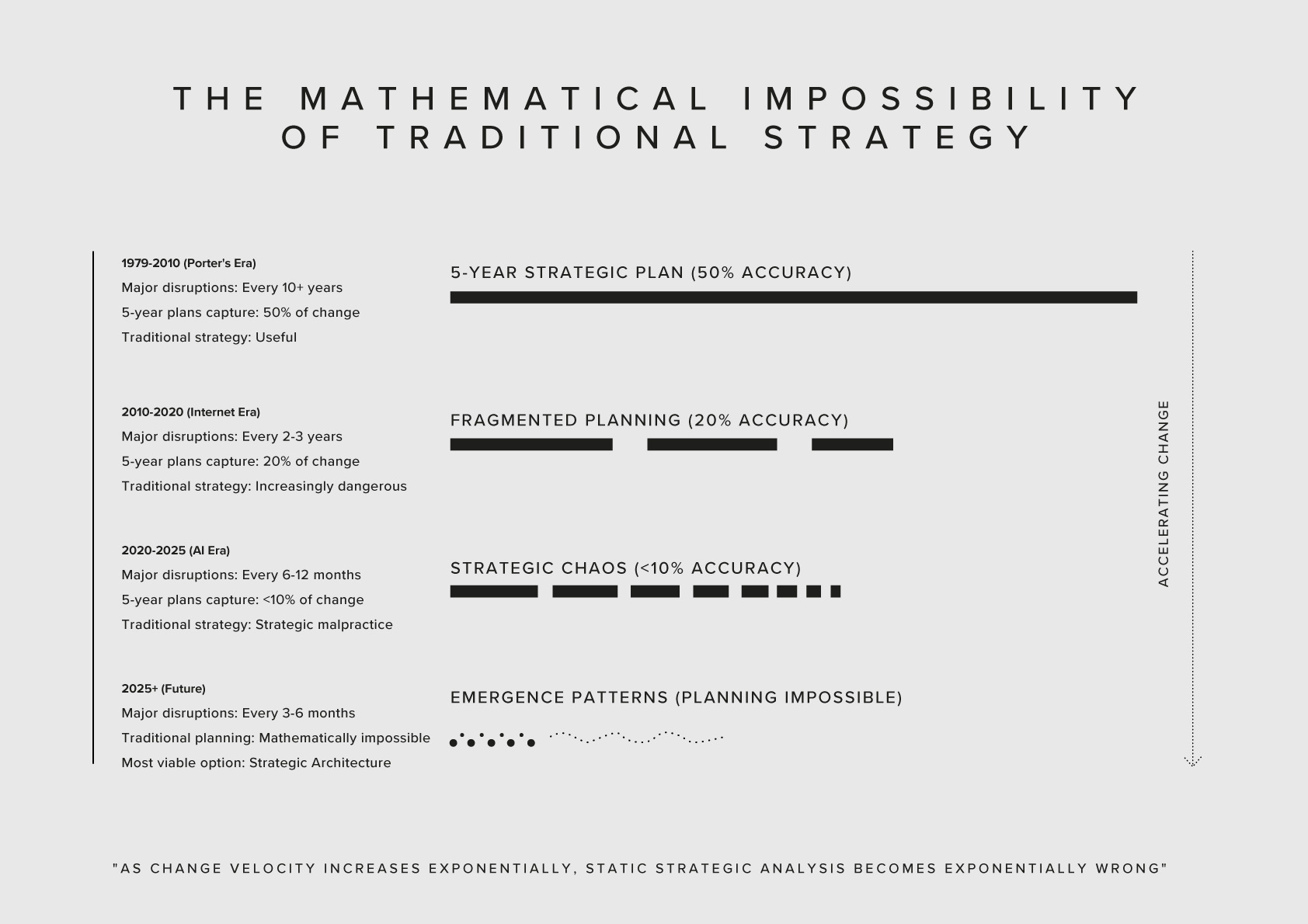
The Mathematical Impossibility of Traditional Strategy
Porter’s Era (1979–2010):
Major emergence events: every 10+ years
5-year strategic plans captured ~50% of relevant change
Internet Era (2010–2020):
Major emergence events: every 2–3 years
5-year plans captured ~20%
AI Era (2020–present):
Major emergence events: every 6–12 months
5-year plans capture <10%
The math is unforgiving: as change velocity accelerates, static strategy becomes exponentially wrong.
The Choice: Fragile vs. Antifragile
We’re at a historical inflection point. Every business faces a fundamental choice:
Fragile Systems (Traditional Strategy): break under volatility, require stability, weaken under stress.
Antifragile Systems: get stronger from volatility, benefit from disruption, evolve under stress.
“The goal isn’t to survive disruption — it’s to turn disruption into fuel.”
The Bottom Line
In the AI era, emergence isn't a risk to manage — it’s the primary source of competitive advantage. The choice is simple: build strategies that break when the world changes, or architectures that get stronger because it does.
I don't have all the answers nobody does. These frameworks are simply how I make sense of the chaos. Take what serves you, leave what doesn’t, and keep building.
Building Strategic Architecture™, Edward Azorbo