
#3 Power Numbers

Welcome to the Strategic Architecture Universe: where strategy becomes mathematics not guesswork, transformation hides in precise thresholds not percentage increases, and execution reveals the numbers that actually matter.
Edward Azorbo
Power Numbers: Why Your Business Metrics Are Lying to You
I was never much of a science person. In fact, I barely passed my math classes. Yet ironically, in business, I've developed a near-obsession with certain types of numbers. I credit this to human biology, specifically our fight-or-flight response. When faced with uncertainty, we instinctively search for clarity, for something concrete to hold onto.
Using numbers to create certainty (or at least the illusion of it) is probably what made them such a powerful strategic tool for me. But not just any number. The right number.
I remember the moment this clicked for me. I was reviewing our marketing budget and facing a decision: invest in expanding our graphic design team or build a high-quality video production capability. Both required roughly the same financial investment, about the same number on the balance sheet. But I realized that while one was simply an expense, the other was a Power Number that would transform our strategic position in the industry.
Micro-summary:
→ Not all numbers are equal. Some measure what happened. Power Numbers transform what's possible.
Mathematical thresholds that transform
That investment in video production didn't just improve our marketing. It became a moat that competitors couldn't easily cross, established us as category leaders, and created retargeting audiences that became strategic assets. Same investment number, completely different strategic impact.
I've come to believe that the ability to identify precise mathematical thresholds that trigger cascading positive effects might be one of the most valuable strategic skills anyone can develop.
The Problem with Traditional Numbers
I spent years chasing the wrong numbers. Revenue growth targets, percentage increases, market share goals. The metrics that every business book tells you to focus on. I'd hit these targets, celebrate briefly, then realize nothing fundamental had actually changed in my business.
The breakthrough came when I stopped asking "How much bigger should this number be?" and started asking "Which numbers would actually transform how my business operates?"
Micro-summary:
→ Traditional metrics track progress. Power Numbers™ create transformation. The difference is everything.
The Percentage Trap
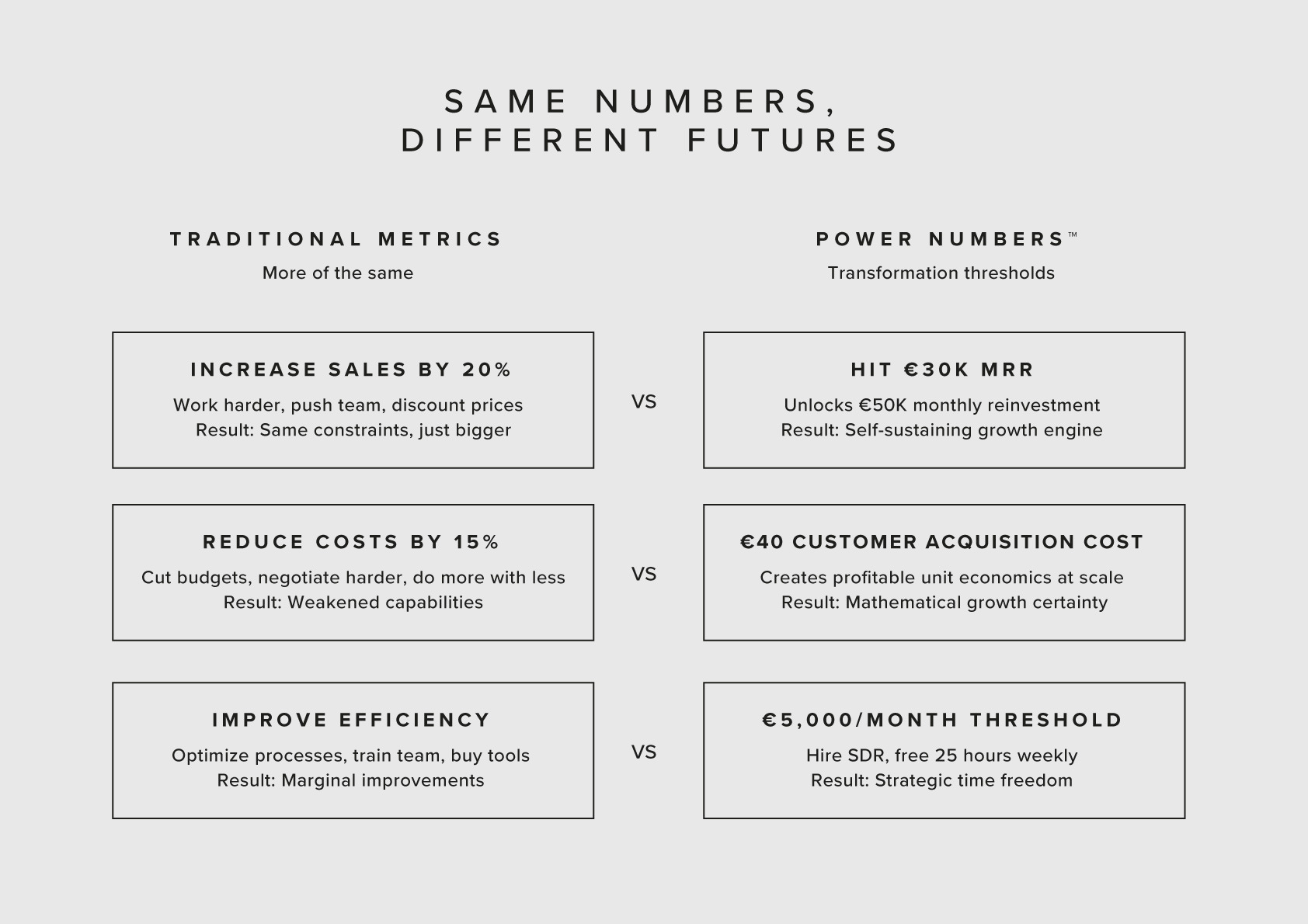
Take the classic goal: "Increase sales by 20% this quarter." It sounds strategic, measurable, achievable. But here's what I learned the hard way: you can hit that 20% increase through a hundred different ways, most of which leave your business essentially unchanged.
You might work longer hours, push harder on existing clients, or run a discount promotion. You hit the number, but you're still trapped in the same systems, facing the same constraints, operating at the same level. The 20% becomes just a bigger version of the same problems.
I remember hitting several of these percentage goals over the years, only to find myself asking: "Now what?" The number went up, but the strategic freedom I was seeking never materialized.
The Resource Scarcity Advantage
I remember looking back at the beginning of our business when me and my partner Alexandra started our marketing agency with a €3,000 credit card. When you have few resources, you tend to be more intuitively connected to the right numerical thresholds that will give results.
At those early stages, every euro had to count. We couldn't afford inefficient decisions because there was no buffer for waste. That €3,000 had to transform into something bigger, and it did, because we were forced to find the precise leverage points that would create maximum impact.
But at later stages, I made decisions like paying for inefficient team members, amounts that, if redirected, would have changed the business in so many ways. I look back at how much leverage I got from that €3,000 credit card, and how little from many wrong decisions allocating financial resources to things that felt important but created no transformation.
Micro-summary:
→ Resource scarcity forces Power Number thinking. Abundance often leads to lazy number choices that feel important but change nothing.
This has led me to a point where, before investing or taking on any fixed cost, I ask: "Will this really unlock any transformation? Is it truly necessary? Can someone else do it without me having to pay more?" These questions force me back to the Power Number mindset, focusing on thresholds that create change, not just numbers that create comfort.
The Measurement vs. Transformation Confusion
Most business numbers fall into what I now call "measurement numbers." They tell you what happened, but they don't change what's possible. Revenue, profit margins, customer count. These track your progress but don't unlock new capabilities.
Power Numbers are different. They're transformation triggers disguised as metrics. When you hit a Power Number, you don't just have more of something. You can do things that were previously impossible.
Consider the difference: A traditional goal might be "increase monthly revenue by €10,000." A Power Number™ approach asks: "What's the specific revenue threshold that would allow us to hire a senior developer who could automate our most time-consuming process?"
Same €10,000, completely different strategic impact. One gives you more money to manage; the other gives you time freedom and system evolution.
Micro-summary:
→ Measurement numbers tell you where you've been. Power Numbers™ unlock where you can go.
The Strategic Blindness
The real tragedy is that while you're focused on moving the big, obvious numbers, you often miss the small, precise thresholds that would actually transform your business. You chase the €100K revenue goal while overlooking the €5K threshold that would let you delegate your biggest bottleneck.
This blindness to transformation numbers is what keeps businesses stuck in what I call "linear growth hell." Where more effort creates more results, but never creates different results. You scale your problems instead of solving them.
The moment I shifted from chasing percentage increases to identifying transformation thresholds, everything changed. Instead of working harder to move bigger numbers, I started working smarter to hit precise numbers that unlocked exponential changes in what my business could achieve.
“This blindness to transformation numbers is what keeps businesses stuck in what I call "linear growth hell." Where more effort creates more results, but never creates different results. You scale your problems instead of solving them.”
Micro-summary:
→ Linear growth hell: when more effort creates more results but never different results. Power Numbers break this cycle.
Why Most Businesses Miss This
Despite the obvious benefits of focusing on transformation thresholds rather than arbitrary growth targets, most businesses continue chasing the wrong numbers. Understanding why this happens can help you avoid the same traps.
The Seduction of Bigger Numbers
There's something psychologically satisfying about big, round numbers. "Double our revenue" sounds more impressive than "hit €30,000 MRR." But impressive-sounding goals often miss the point entirely.
I've seen businesses celebrate hitting million-dollar revenue milestones while remaining fundamentally unchanged in their operations, constraints, and strategic position. The big number provided a dopamine hit but no transformation.
Power Numbers are often smaller, more specific, and less impressive-sounding. €5,000 to hire an SDR doesn't sound as exciting as "increase sales by 50%," but it's infinitely more powerful because it creates systematic change.
Missing the Transformation Potential
Perhaps most critically, many businesses lack the analytical frameworks to identify transformation points in their data. They track metrics but don't look for the patterns that reveal precise thresholds where performance shifts.
The businesses that consistently outperform their competitors aren't necessarily working harder. They're working at the right thresholds. They understand that strategic power comes not from moving all numbers up, but from identifying and hitting the specific numbers that transform their entire system.
“The businesses that consistently outperform their competitors aren't necessarily working harder. They're working at the right thresholds.”
The Five Types of Power Numbers
After years of tracking metrics that looked impressive but changed nothing, I've identified five distinct types of numbers that actually transform businesses. Each serves a different strategic purpose, but all share that essential quality of creating clear before-and-after states in your operations.
Freedom Numbers: The Liberation Thresholds
Freedom Numbers are specific thresholds that, once crossed, liberate you from critical constraints. For a consultant trapped doing all their own prospecting, €5,000 monthly revenue isn't just "more money." It's the exact threshold needed to hire an SDR. Cross this number, and suddenly 20-30 hours per week are freed for strategic work.
In our subscription business Velocity, €30,000 in monthly recurring revenue was our freedom threshold. At €40 Customer Acquisition Cost and 15% monthly churn, we could sustain 5,000 subscribers at €50,000 monthly revenue capacity. When we reinvested that entire €50,000 back into growth, we hit mathematical inevitability.
Validation Numbers: The Proof Points That Signal Readiness
Validation Numbers provide mathematical certainty that your system works and is ready to scale. In Velocity, we identified three critical metrics: €40 Customer Acquisition Cost, minimum 30 sales per day, and maximum 15% monthly churn. When we hit these simultaneously, we had mathematical proof we could profitably scale.
Transformation Numbers: The Tipping Points That Emerge from Execution
These reveal themselves through execution rather than planning. In our consulting business, we discovered that sales representatives scoring above 85 on our AI call-scoring system consistently hit 20% conversion rates, while those below 85 rarely exceeded 12%. That 85 score became a data-driven threshold that reliably transformed individual performance.
Capability Numbers: The Investment Thresholds That Unlock New Futures
Capability Numbers represent investments that unlock fundamentally different strategic possibilities. We faced this with a €10,000 monthly decision: content marketing team or AI development team. Same number, completely different futures. The AI team unlocked automated systems, scalable operations, and compound advantages competitors couldn't easily replicate.
Protection Numbers: The Early Warning Systems
While most metrics focus on growth, Protection Numbers ensure stability. For our media brand, newsletter open rates aren't vanity metrics. They're direct indicators of list health that impact our entire system. When rates approach our threshold, we know we need immediate action to protect our most valuable asset.
In Part 2, I'll show you the exact framework for identifying these Power Numbers™ in your business, plus the specific recognition questions that consistently surface the numbers that matter most.
Until then, look at your current business metrics and ask: "Are these numbers measuring what happened, or are they creating what's possible?"
The answer might reveal why your growth feels harder than it should be.
Power Numbers Part 2: The Recognition Framework That Finds Your Transformation Thresholds
In Part 1, I shared the five types of Power Numbers that actually transform businesses instead of just measuring them. But knowing the types is only half the battle. The real skill lies in recognizing which specific numbers would create transformation in your business right now.
After identifying hundreds of Power Numbers across different businesses, I've discovered that this isn't mystical intuition. It's a learnable skill that comes down to asking the right questions and thinking systematically about what would actually change your operations.
The businesses that consistently outperform their competitors have developed this recognition ability. They can look at their metrics and immediately spot the difference between numbers that track progress and numbers that create possibilities.
The Recognition Framework: Three Questions That Surface Everything
The framework I'm about to share consistently surfaces the Power Numbers that matter most. These aren't abstract strategic questions. They're diagnostic tools that force you to think precisely about transformation thresholds.
Question 1: "What threshold would fundamentally change what's possible in our business?"
This question identifies Freedom and Capability Numbers. Look for constraints that, once removed, would unlock entirely new operational possibilities. The €5,000 SDR threshold is a perfect example. It's not about having more money; it's about the strategic freedom that specific amount creates.
Start by listing your biggest bottlenecks, then calculate the exact investment needed to remove each one. Often, the numbers are smaller than you think, but their impact is exponentially larger.
Micro-summary:
→ Your biggest constraints often have smaller price tags than you think. Calculate the exact threshold to remove each bottleneck.
Real Example: A client was personally handling all customer support, spending 25 hours weekly on issues that could be systematized. The Freedom Number wasn't "hire more people." It was €3,500 monthly for a customer success specialist €3,500 to reclaim 25 hours weekly for strategic work.
The precision matters. "Hire support staff" is vague and expensive. €3,500 monthly threshold to eliminate 25-hour weekly constraint" is a Power Number™ that creates immediate clarity and action.
Question 2: "What metrics would prove our system is ready for the next level?"
This surfaces Validation Numbers, the proof points that give you mathematical confidence to scale. Look at your unit economics, conversion rates, and retention metrics. What specific thresholds would need to be met simultaneously to prove your model works at scale?
In our case, it was the combination of €40 CPA, 30 daily sales, and 15% churn that created validation. No single metric was sufficient; it was the intersection that created certainty.
Micro-summary:
→ Validation isn't one perfect metric. It's multiple thresholds hit simultaneously that create mathematical certainty.
The Pattern: Most businesses track individual metrics but miss the combinations that create validation. You need CPA and volume and retention working together. When all three align at specific thresholds, you have mathematical proof your system works.
Framework Application: List your three most critical business metrics. For each, identify the specific threshold that signals "ready to scale." Then test whether you've achieved all three simultaneously. If not, you know exactly where to focus.
Question 3: "What early warning signals protect our most valuable assets?"
This identifies Protection Numbers, the metrics that safeguard what you've already built. Think about your most valuable business assets: customer lists, brand reputation, key relationships, proprietary systems. What numbers, if they started declining, would signal that these assets were at risk?
Our newsletter open rates are a perfect example. They're a leading indicator of list health that impacts everything from future sales to asset value.
Micro-summary:
→ Protection Numbers are early warning systems. They tell you when your most valuable assets are at risk before it's too late.
The Asset Protection Audit: Make a list of your five most valuable business assets. For each asset, identify the one metric that best indicates its health. Set specific thresholds where decline becomes dangerous. These become your Protection Numbers™.
Example: If your email list is a core asset, track not just size but engagement. When open rates drop below 25% or click rates fall under 2%, your asset is deteriorating regardless of list growth.
The Pattern Recognition Element
The more Power Numbers you identify and track, the better you become at recognizing them. You start to see potential transformation points that would have been invisible before. You develop an instinct for the difference between numbers that measure and numbers that transform.
This isn't about tracking more metrics. It's about developing the analytical eye to spot transformation thresholds in your existing data.
Micro-summary:
→ Transformation thresholds hide in your existing data. The skill is learning to see combinations that create inevitability, not just improvement.
“You start to see potential transformation points that would have been invisible before. You develop an instinct for the difference between numbers that measure and numbers that transform.”
The Simplicity Test
The most powerful Power Numbers are often remarkably simple. They don't require complex formulas or elaborate frameworks. They're clear, binary thresholds that anyone in your organization can understand and work toward.
If you can't explain why a specific number matters in one sentence, it's probably not a true Power Number. The power comes from clarity, not complexity.
Examples of Clear Power Numbers:
"€5,000 monthly lets us hire an SDR and free 25 hours weekly"
"85 AI score consistently delivers 20% conversion rates"
"€30K MRR enables growth to €50K reinvestment for inevitable growth"
"25% open rate maintains list asset value"
Examples of Non-Power Numbers:
"Improve customer satisfaction scores"
"Increase market penetration"
"Optimize conversion funnel performance"
"Enhance brand awareness metrics"
Notice the difference? Power Numbers connect specific thresholds to specific transformations. Vague metrics connect to vague outcomes.
The Mathematical Art of Strategic Thinking
Power Numbers represent something profound: the intersection of mathematical precision and strategic insight. They're where data science meets business intuition, where execution meets transformation.
In a world obsessed with complex strategic frameworks and five-year plans, Power Numbers offer something different: execution-driven transformation points that create before-and-after states in your business.
Micro-summary:
→ Power Numbers turn strategy from guesswork into mathematics. When you hit the right thresholds, transformation becomes inevitable.
Like I mentioned in Part 1, my obsession with numbers most likely comes from fear, looking for refuge in numbers when faced with uncertainty. But I've come to realize that as entrepreneurs, we fundamentally crave two things: predictability and momentum.
The beautiful irony is that my refuge in numbers, when focused on the right ones, actually helps me get more of both. Power Numbers don't just measure what happened. They create the conditions where what you want to happen becomes mathematically probable.
The ability to identify these precise thresholds, to see the difference between numbers that measure and numbers that transform, might be one of the most valuable strategic skills you can develop.
Your business is full of transformation thresholds waiting to be discovered. The question isn't whether they exist. The question is whether you'll develop the recognition skills to find them.
I don't have all the answers nobody does. These frameworks are simply how I make sense of the chaos. Take what serves you, leave what doesn’t, and keep building.
Building Strategic Architecture™, Edward Azorbo