
#1 The Language That Limits: Why Strategic Thinking Needs New Words


Welcome to the Strategic Architecture Universe: where new language creates new realities, traditional words limit traditional outcomes, and precision in terminology unlocks strategic possibilities invisible to others.
Edward Azorbo
The Language That Limits: Why Strategic Thinking Needs New Words
Language has always fascinated me. Growing up multicultural with a Swedish mother, Nigerian father, born in the UK, now living in Spain, I’ve experienced firsthand how certain words from different languages capture realities that others simply cannot.
Take the Spanish word chicha. It describes someone with character, willpower, energy, vitality, but it’s more than that. It can apply to a song, food, a piece of content, even a business strategy. When Spanish speakers hear chicha, they understand immediately. Try to translate it into Swedish or English, and something essential is lost. The concept itself becomes weaker, less precise.
I watch my six-year-old daughter do this instinctively, switching from Spanish to English mid-sentence when one language captures what she means better than the other. She’s not showing off; she’s reaching for the most precise tool to express her reality.
Ludwig Wittgenstein suggested that the scope of our understanding and experience of the world is limited by the language we possess. I believe this completely. And I’ve come to believe that in this era of massive change, the traditional “language” of strategy is no longer enough.
I remember spending time with strategy books: Porter, Collins, the usual suspects. Not aimlessly, just looking for frameworks that would actually help me build better businesses.
What struck me wasn’t that these frameworks were wrong, but that something felt off when I tried to use them. When I focused on “competitive advantage,” I’d get stuck analyzing competitors instead of building. When I set “SMART goals,” I’d hit them but my business would feel essentially the same. When I tried to build “flywheels,” I’d optimize what already existed instead of creating something new.
The words themselves seemed to be steering my thinking in directions that didn’t quite fit what I was trying to accomplish.
The Language Trap
Traditional strategy language creates traditional thinking. When we use words like “goals,” “planning,” and “metrics,” we unconsciously limit ourselves to specific ways of seeing and acting.
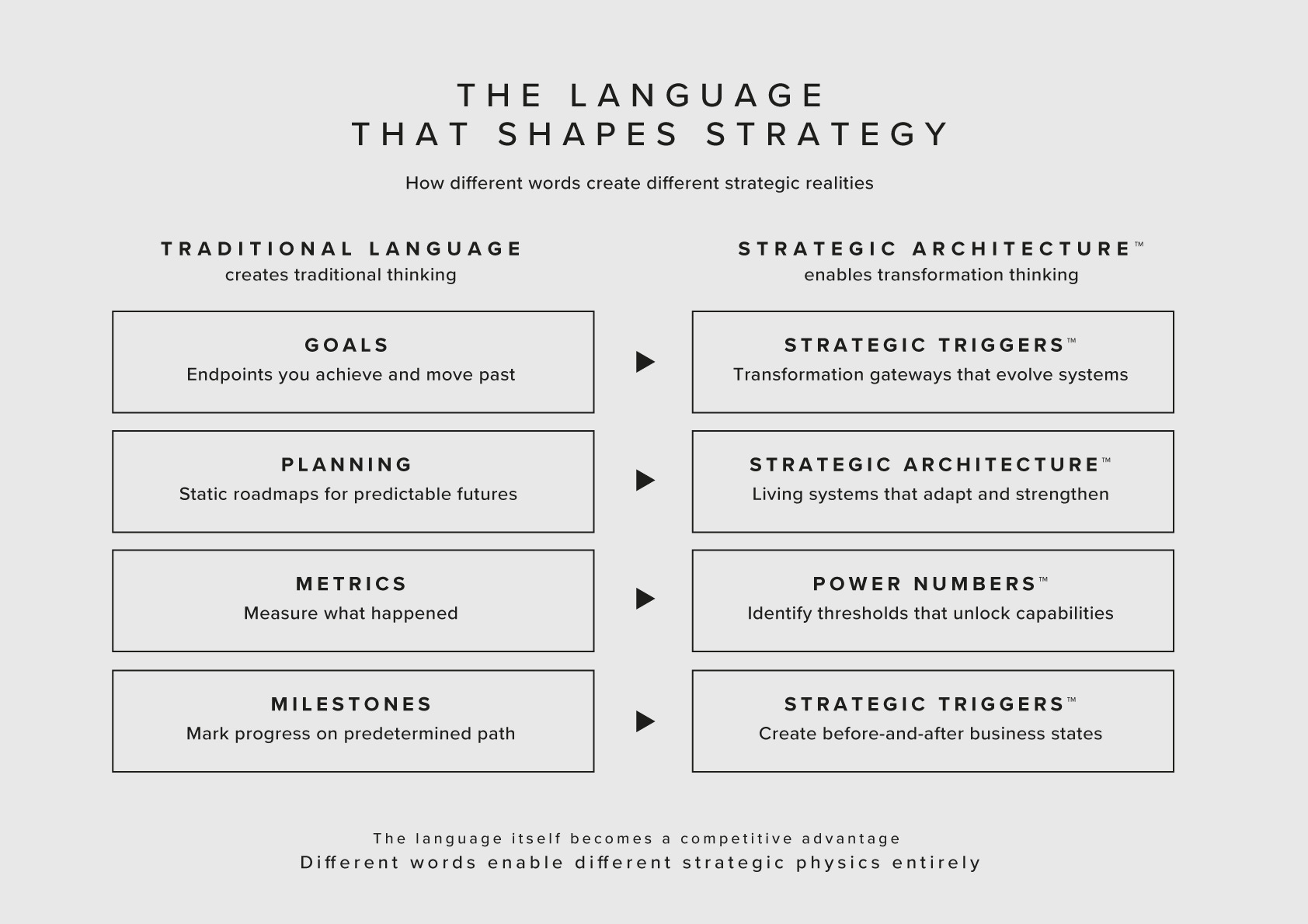
Consider how these word pairs shape completely different approaches:
Goals vs. Strategic Triggers – Goals are endpoints you achieve and move past. Triggers are transformation gateways that evolve your entire system.
Planning vs. Strategic Architecture – Planning creates static roadmaps for predictable futures. Strategic Architecture designs living systems that adapt and strengthen over time.
Metrics vs. Power Numbers – Metrics measure what happened. Power Numbers identify thresholds that unlock new capabilities.
Milestones vs. Strategic Triggers – Milestones mark progress along a predetermined path. Strategic Triggers create before-and-after states in your business.
The difference isn’t semantic. “Increase revenue by 20%” leads to optimization thinking: how do I make the current system produce more? “Identify the Freedom Number that creates strategic independence” leads to transformation thinking: what specific threshold fundamentally changes what’s possible?
€10,000 in recurring revenue that allows you to build a team that frees 20 hours a week and opens up leverage for you to produce more value somewhere else could be transformational.
But frame that same €10,000 as “20% growth” and you stay stuck optimizing the old system, rather than upgrading the architecture.
“Traditional strategy language creates traditional outcomes. To change what’s possible, you have to change the words you use.”
Strategic Architecture Alternative
Strategic Architecture represents a complete linguistic reframe of how we think about strategy. Instead of language that constrains thinking to incremental improvement, it uses language that opens up systematic transformation.
This isn’t about replacing every business term. It’s about having access to distinctions that enable different types of strategic thinking. When you can think in terms of “Strategic Surplus” instead of just “profit margins,” you start seeing resources as tools for creating strategic freedom rather than just numbers to optimize.
When you understand “Cascade Thinking” instead of just “cause and effect,” you start designing actions that create multiple waves of impact across interconnected systems rather than isolated improvements.
The language itself becomes a competitive advantage because it enables you to see and act on possibilities that traditional strategic language keeps invisible.
I remember the exact moment I decided to invest €3,000 a month into building our streaming platform for Velocity.
It was either that or hire a marketing assistant.
At the time, I had just begun shaping the Power Numbers framework.
And in that moment, I realized what I was really doing: not spending money, but acting on a Capability Number one of the five types I had started to define.
We committed to the platform over a 12-month period.
When we launched, churn dropped by 1.5% almost immediately.
It became a clear path to strong ROI, and beyond that, the platform itself became a strategic asset.
It changed how people perceived the product. It deepened trust.
It wasn’t just delivery infrastructure — it became part of the brand.
That shift in language made it possible to see all of that clearly.
From a recurring cost to long-term leverage.
From hesitation to conviction.
That’s what precise language can do.
It gives shape to intuition.
It turns uncertainty into clarity.
And it lets you act from frameworks that weren’t available to you before the words existed.
“The right language doesn’t just describe your strategy it reshapes the reality you can build.”
The Bigger Picture
This represents more than improved terminology. It’s a fundamental shift in how strategic thinking works in the AI era.
Traditional strategy language was built for a world where industries transformed every decade. In that context, “five-year plans” and “competitive analysis” made sense. But when entire categories emerge and dissolve in months, that language becomes not just inadequate but actively dangerous.
Strategic Architecture language is designed for exponential change and emergent opportunities. It assumes that the most valuable possibilities will be unpredictable, that systems need to evolve continuously, and that success comes from capturing emergence rather than following plans.
The businesses that will thrive in the next decade won’t be those with better execution of traditional strategies. They’ll be those who can think and act using language that enables different strategic physics entirely.
Language ownership creates strategic advantage because it shapes not just how you think, but how your team thinks, how your market thinks, and ultimately how reality unfolds around your business. When you control the distinctions people use to think about strategy, you influence the strategic outcomes they can achieve.
Linguistic Territory as Strategic Moat
Own the words, and you own the rules of the game.
I find what CrossFit has done fascinating. It’s a textbook example of how a brand doesn’t just grow, it creates a movement and an entire language.
They didn’t just open gyms. They redefined what a gym was.
“Box” instead of gym.
“WOD” instead of workout.
“Functional fitness” instead of cardio or bodybuilding.
They didn’t compete in the old category; they named a new one.
And once they did, everything bent around it.
Trainers became “Level 1 Certified.”
Athletes posted whiteboard scores.
The word “CrossFit” wasn’t just a brand, it was an identity.
That’s the power of linguistic territory.
When you invent the words, you install the worldview.
People don’t just buy your offer, they start thinking in your terms.
And once they speak your language, they see the world the way you see it.
You don’t have to be the loudest. You just have to be the one who names what others have been trying to describe.
I’m still figuring this out myself, but the question I keep returning to is this:
What’s the language that, if others started using it, would quietly shift the way they think?
That might be where the real moat begins.
A Living Language for a Changing World
My intention with this piece isn’t to claim final answers, but to question whether the language we’ve inherited is still helping us build what the future demands.
Over the past few years, I’ve been working to reshape the language of strategy not by adapting old terms to new contexts, but by trying to develop a vocabulary native to the AI era — one designed for emergence, speed, and system-level thinking.
It’s a work in progress. I don’t see it as a fixed set of definitions, but as a living toolkit a language that evolves alongside the environments we’re all trying to navigate.
“Language is the first architecture. Change the words, and you change the structure of possibility.”
An Invitation to Examine
I’m not suggesting that Strategic Architecture language is the answer to every strategic challenge, or that traditional frameworks have no value. Many of them were brilliant for the contexts they were designed for.
But I do think we need to honestly examine whether the language we inherited from previous eras still serves us in this one.
When change happens in months rather than years, when AI accelerates both opportunity and disruption, when emergence becomes the primary source of competitive advantage, maybe it’s worth questioning whether our strategic vocabulary is keeping up.
This isn’t about replacing everything wholesale. It’s about being willing to examine old paradigms and consider whether new distinctions might open up possibilities we can’t currently see.
The frameworks I’ve developed work for me and the businesses I’ve been involved with. They might work for you, or they might not. But the broader principle — that language shapes strategic possibility — seems worth exploring regardless of which specific words you choose to use.
We’re all figuring this out together. What I hope to do is share, to as many as possible, what I’ve learned about how different language can lead to different strategic outcomes, and invite you to experiment with whatever distinctions feel most useful for the future you’re trying to create.
I don't have all the answers nobody does. These frameworks are simply how I make sense of the chaos. Take what serves you, leave what doesn’t, and keep building.
Building Strategic Architecture™, Edward Azorbo