
#6 The Five Big Ideas of Strategic Architecture

Welcome to the Strategic Architecture™ Universe: where emergence is fuel, chaos creates opportunities, and execution drives strategy rather than following it.
Edward Azorbo
The Five Big Ideas of Strategic Architecture
One of the biggest challenges when you have knowledge you believe could help others is transferring it effectively. You might have spent five years thinking about one big idea, seeing it from all kinds of angles, combining experience with analysis only for someone to hear it once and have it bounce off as if nothing.
This is one reason I have deep admiration for people who can simplify ideas. John Danaher is, to me, one of the greatest BJJ coaches not because his students win competitions (though they do) but because, from learning from him through his DVDs and online publications, I’ve seen how he distills BJJ into clear fundamentals, concepts, and steps. I owe significant gratitude to his teachings for that ability to transfer simplicity.
I didn’t study physics, but having discovered Richard Feynman through Six Easy Pieces, he would be the physics teacher I wish I’d had.
What I present here is my attempt to simplify ideas I’ve thought about, refined over time, applied, and believe may hold value for others.
Strategic Architecture was born from my frustration that traditional strategy was inadequate for someone I would call “execution prone.” I live by “execution first” as a mantra, while traditional strategy focuses almost entirely on planning.
Whenever I’ve created content for events and workshops, I’ve found that talking about the big ideas behind the main idea helps bridge the connection between creator and audience.
These are five big ideas that, I hope, will explain what the Strategic Architecture universe is and what it can do for a business. From my perspective, they offer a new way of understanding strategy born out of my desire to create practical frameworks for people who execute, not just think and theorize about strategy.
Big Idea 1: Execution First, Strategy Emerges
Traditional thinking: Think → Plan → Execute
Strategic Architecture: Execute → Learn → Evolve
“Strategy isn’t something you figure out in a room. It emerges from contact with reality.”
Ask any successful entrepreneur and they’ll tell you: every action teaches you something planning never could. Strategy is discovered through execution, not designed in isolation.
Simple example: You can’t plan your way to product–market fit. You find it by launching, learning, and adjusting. The strategy emerges from what works.
Big Idea 2: Structure AND Emergence (Not OR)
Traditional thinking: Progress is linear and gradual
Strategic Architecture: Transformation happens at specific thresholds
The right constraints create more possibilities, not fewer. In BJJ, you learn and mechanize techniques, you have a game plan (structure). In the fight, you use that structure to capitalize on what your opponent gives you (emergence). Without structure, you flail. Without emergence, you’re predictable.
We might need a predictable plan to test our product, but the market can give us unexpected information. We need to be ready to capture whatever emerges especially in today’s AI-driven, fast-changing environment.
Simple example: A jazz band needs chord structure to improvise. No structure = noise. Too rigid = boring. Structure + emergence = magic.
Big Idea 3: We Evolve Through Gateways
Traditional thinking: Progress is linear and gradual
Strategic Architecture: Transformation happens at specific thresholds
You don’t slowly become better. You hit specific points—Strategic Triggers—that completely change the game. Like water turning to steam at exactly 100°C, these gateways become your growth engine.
Inflection points always exist. The “hockey stick” growth curve exists because of them. Look at any successful company or person and you’ll find moments where everything shifted transformation points where crossing a specific threshold unlocked entirely new capabilities.
Simple example: A startup at breakeven in recurring revenue is a stable system. The same startup with an additional €20k monthly to invest in growth has reached a transformation point. Same business, completely different possibilities.
Big Idea 4: Strategic Triggers Replace Goals
Traditional thinking: Set goals, work toward them
Strategic Architecture: Identify strategic triggers™, transform through them
“Goals are arbitrary human inventions. Strategic triggers are mathematical reality. They can be found, identified, and executed.”
When you hit 15 sales per rep, something changes. When you reach $10k MRR, new options unlock. Triggers create evolution; goals create pressure.
Simple example: Goal: $1M revenue → creates stress.
Trigger: 50 customers transforms capacity → creates focus on what actually changes the business.
Big Idea 5: Everything Compounds or Dies
Traditional thinking: Maintain what works
Strategic Architecture: Build systems that strengthen themselves
Nothing stays the same. Your systems either get stronger every time you use them, or they slowly fall apart. Every customer should make acquiring the next one easier. Every framework should reinforce others. Every cycle should improve the system.
Simple example: When we started investing in high–quality cinematic video, it didn’t just improve sales. It built our audience, strengthened our market position, and became one of our biggest strategic assets.
Why These 5 Big Ideas?
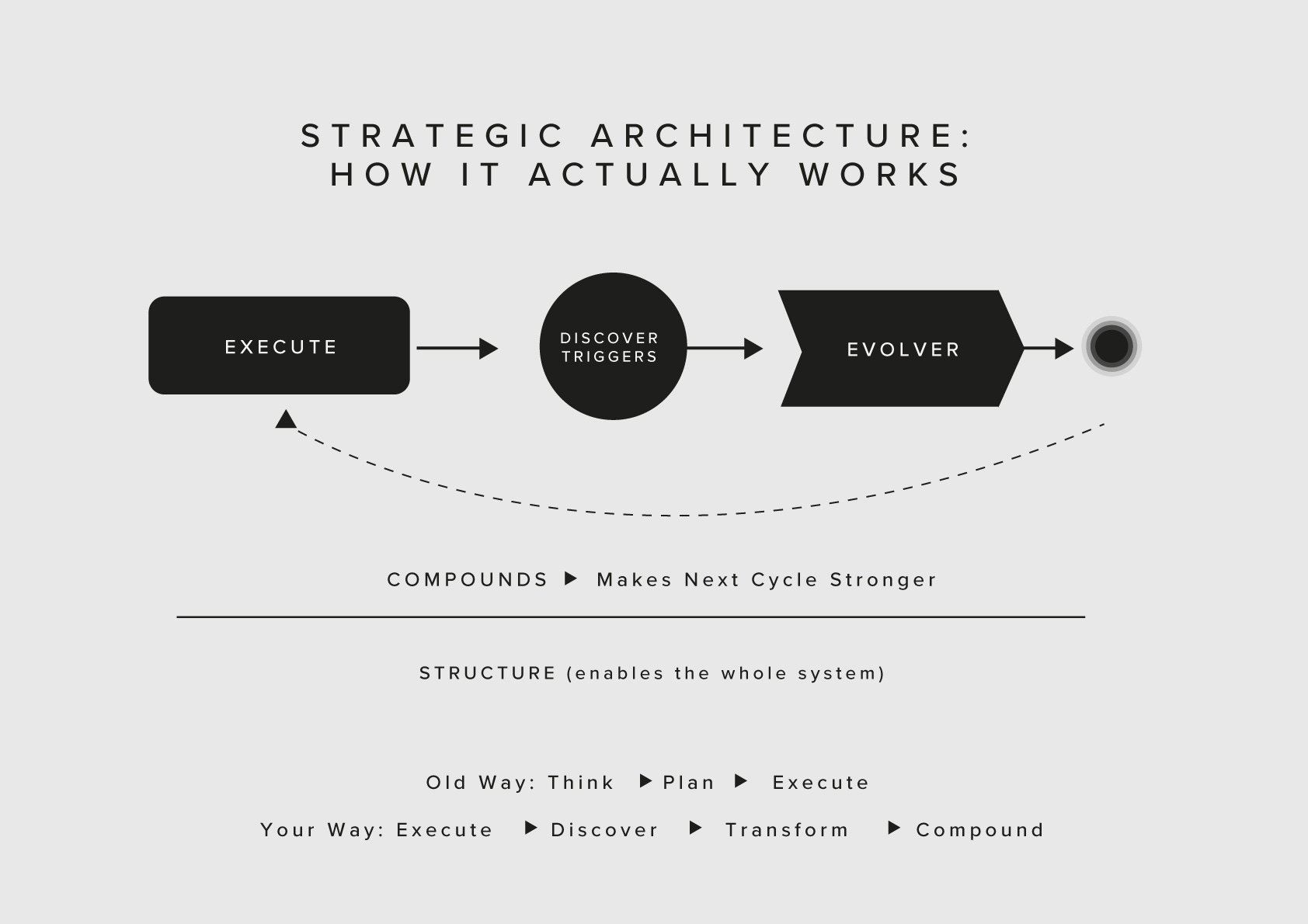
These ideas reveal the operating system:
Execution First = How strategy actually develops
Structure + Emergence = The fundamental dynamic
Gateway Evolution = How transformation happens
Triggers vs Goals = What we navigate toward
Compound or Die = The iron law of systems
From an Integration Power perspective:
Execution reveals Triggers
Triggers create Evolution
Structure enables this evolution to Emerge
Everything compounds through repetition
The system gets stronger, making the next trigger easier
Together, they form a potential complete operating system for inevitable success.
The Profound Shift
Instead of pushing toward arbitrary goals, we focus on discovering and moving through transformation points that actually exist in reality.
Old Way: Set goal → Make plan → Push toward goal → Measure progress
Your Way: Execute → Discover trigger → Transform through gateway → Compound gains → Execute at new level
The Simplest Truth
Strategic Architecture isn’t about working harder. It’s about understanding how transformation actually happens—and moving with it instead of against it.
Like water flowing downhill finds its natural paths, businesses flowing through triggers follow a natural course of evolution.
I don't have all the answers nobody does. These frameworks are simply how I make sense of the chaos. Take what serves you, leave what doesn’t, and keep building.
Building Strategic Architecture™, Edward Azorbo